


There’s a viral article making the rounds today claiming that the current landscape of AI is like the COVID in the early days of 2020.
The author (or the AI the author used to write the article lol) argues that the rumblings we hear about the advancements of AI are just like those early news reports of a novel virus in Wuhan or a few cases in Italy. He claims we are standing on the precipice of a world-shaking event that will fundamentally alter our lives.
The author may be right, but for the wrong reason.
We tend to look back at COVID as an economic disaster, but the truth is, we largely recovered from the financial shock. What we did not recover from was the social changes the pandemic brought about.
If you look at the vestiges of the pandemic that stuck around, it isn’t social distancing, masks, or vaccination cards. It’s the ubiquitous Zoom calls, grocery delivery, and virtual Church attendance. The “new normal” the pandemic achieved was increasing the ways we use technology to remove ourselves from human interaction.
And that is what AI is poised to do.
The tech gurus prophesy that AI will take our jobs. Maybe it will. But we have survived economic shifts before and we adapted. What we rarely recover from is the community effects of new technologies. Cars made our communities regional. Planes national. The Internet international.
The real danger is not in AI’s economic utility but its social utility.
It’s in the little pieces of advice or council we ask a chatbot instead of going to a friend. It’s the strange way many refer to ChatGPT as “he or “she” instead of “it.” The average consumer is not using AI at their job but to validate feelings, bounce ideas off of, and to replace the friction of human interaction with a compliant virtual companion.
We are keeping other people at arm’s length. Right where we like them.
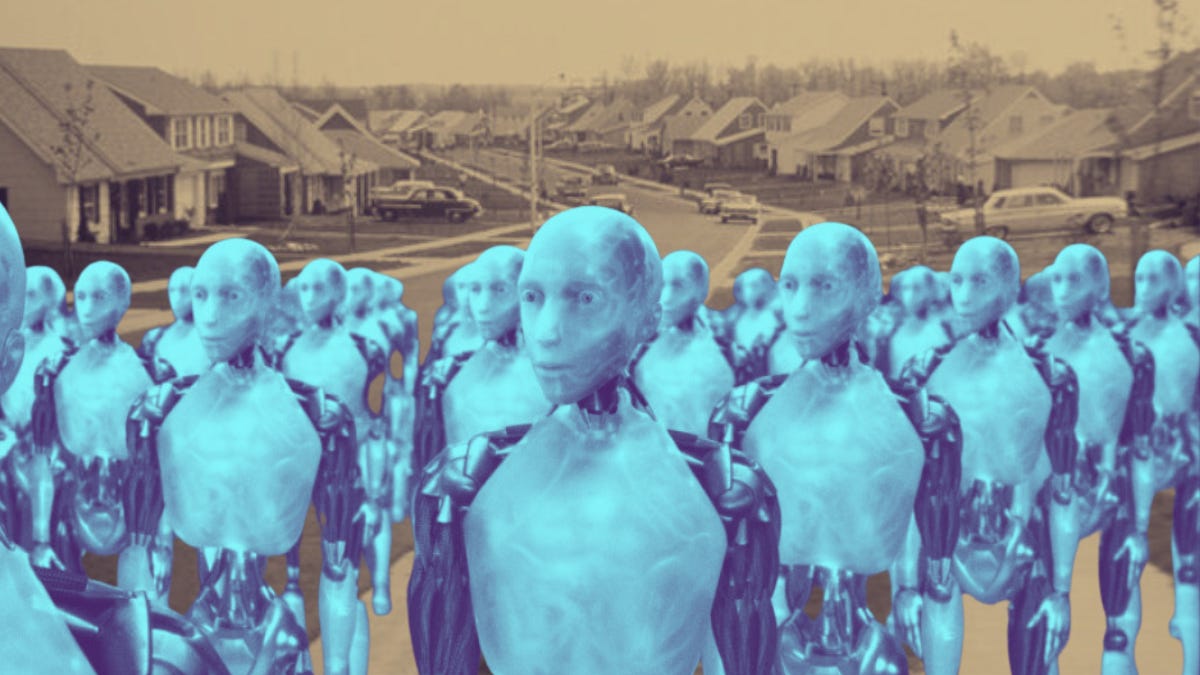
In The Great Divorce, C.S. Lewis described Hell not as a grey town where you can have any house you want. but where everyone quarrels with his neighbor. So, they simply imagine a new house a mile away and then move there. His vision of Hell is an infinitely expanding suburb where we drift further and further apart because we can’t stand to be near one another.
Most of our technological advancements are creating this Hell on earth.
Technology has always greased the wheels of this drift. The telegraph, the phone, the car, the internet—they all promised connection but really made it easier to stay apart. AI is just another accelerant. But the “distance” it creates is when we use it to remove the other person altogether. It allows us to simulate the feeling of a relationship without the “burden” of another person.
This is where the Church must step in.
The Catholic Church is quickly becoming the only institution in the world that must be experienced in person. Many of our jobs can be done remotely. Most of our shopping, too. Even other Christian denominations conceded that “church” could be a livestream. Catholics certainly used livestreams, and the hierarchy bent on dispensing Mass attendance more than we might have liked, but the principle remained: you cannot engage in the Sacramental life remotely.
Worship of God requires physical presence because human community requires physical presence.
As we stare down the barrel of the AI “revolution,” our response as a Church must be a recommitment to the messy, inefficient, in-person reality of parish life.
We need to commit to being with people and loving them. We need to sit in pews next to people we might not even like. We need to serve the poor and know their names.
The world is building tools to help us drift apart. We need to be the people who refuse to move.
Chapter 4 of my new book, Save Your Parish details how the average Catholic can build community in their parish even if they have no institutional support.
Get the #1 New Release in Church Growth here:
The COVID response was exactly what spurred the “ah-ha” moment that tipped me from Protestantism to the Catholic Church. Watching church after church switch to virtual services while the Catholic parishes in our state remained open and faithfully serving the Eucharist forced me to confront the fact that there was no substance in the Protestant worship service that could not be streamed. Our former church only had “communion” once a quarter anyway, so people didn’t really miss it. They tuned into the sermon on YouTube and called it church. This bothered me so deeply that it pushed me from two years of reading the Church Fathers and Catholic books to suddenly looking for a local RCIA (now OCIA) class. COVID had the opposite effect on me, and I am so thankful God used it to draw my family into His one, holy, Catholic, and apostolic Church.
You've got it, Patrick. You've named the nail that's been sticking out where we all can see, but carefully walk around every time we enter the room. I honestly thought you were going to talk about the data centers ruining our neighborhoods, but this is a more subtle and devastating evil. 20/10