


Trump’s recent military action in Venezuela and capture of President Nicolas Maduro have had Americans at each other’s throats for about two days now.
And Catholics are caught in the middle.
As peace-loving people, Catholics tend to recoil at any act of violence. But as people who care for the poor, we recognize that Maduro was an evil leader and was harming the poor in Venezuela.
So we can kind of be caught between these two impulses: care for the poor and love for peace.
Fortunately, Catholic social teaching has the tools we need to work through this.
The Church developed what’s called “just war theory” over centuries, drawing from St. Augustine and St. Thomas Aquinas.
I put together a short guide for Catholics to talk about Venezuela while remaining rooted in Catholic Social Teaching.
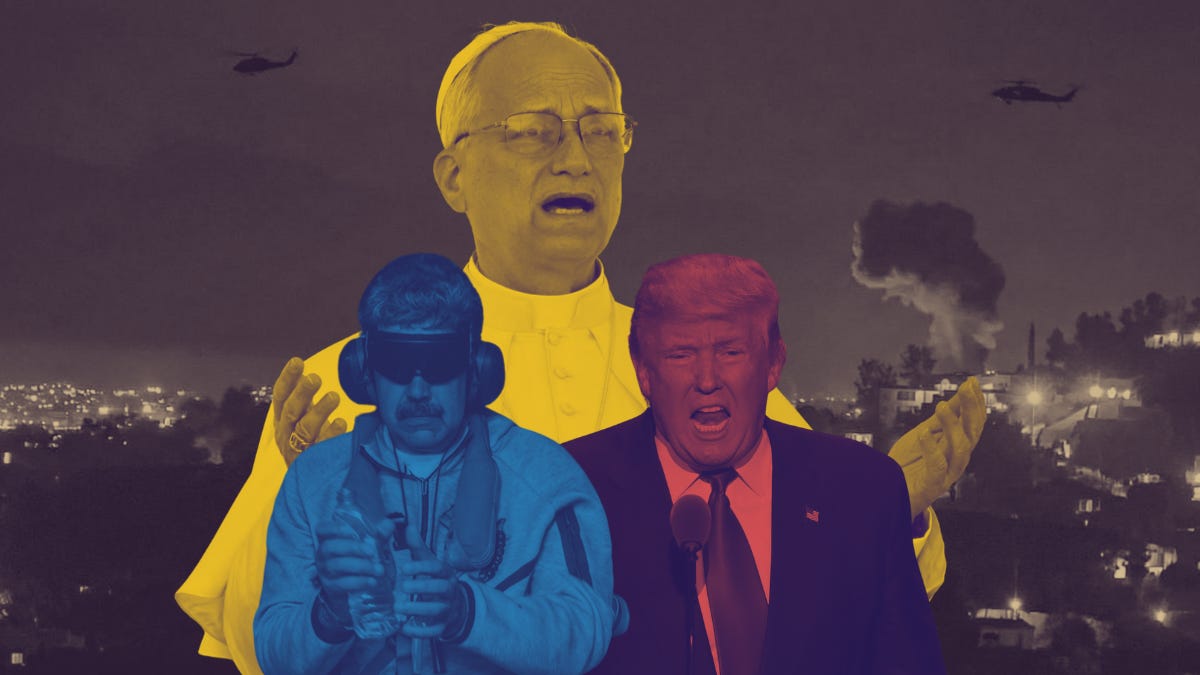
What makes violence just?
First off, it’s important to note that we’re not pacifists as Catholics.
We’re not expected to be pacifists because pacifism would mean that all violence is evil. And we know that sometimes violence is necessary to defend ourselves. If all violence were evil, it would seem that God requires something evil of us—and that’s not the case. It’s clear in the case of self-defense that we have the right (and responsibility) to defend ourselves from people who would attack our families.
But even when it’s not self-defense, we have the same responsibility. For instance, if you see someone getting mugged on the street and you can intervene, you should. It’s not self-defense, but it is a virtuous use of violence.
Violence can be a remedial good. It’s not positively good on its own, but is good in response to sin.
That’s what “just war” is.
It’s laid out in the Catechism of the Catholic Church, paragraph 2309.
The strict conditions for legitimate defense by military force require rigorous consideration. the gravity of such a decision makes it subject to rigorous conditions of moral legitimacy.
At one and the same time:
the damage inflicted by the aggressor on the nation or community of nations must be lasting, grave, and certain
all other means of putting an end to it must have been shown to be impractical or ineffective
there must be serious prospects of success
the use of arms must not produce evils and disorders graver than the evil to be eliminated.
These are the traditional elements enumerated in what is called the “just war” doctrine. The evaluation of these conditions for moral legitimacy belongs to the prudential judgment of those who have responsibility for the common good.
CCC 2309
Just War
There are criteria the Church gives us to evaluate whether a military action is just. You can apply these not just to things we formally call “war”—like something declared by Congress—but to any use of military force.
Here are the criteria and some questions you can consider.
Just Cause — The damage inflicted by the aggressor must be lasting, grave, and certain
Last Resort — All other means are impractical or ineffective
Reasonable Chance of Success — There is a serious prospect of success
Proportionality — The use of force must not produce evils graver than the evil being eliminated
Legitimate Authority — The decision must be made by those with proper authority
Right Intention — The stated reasons must be the actual objectives
How to analyze this conflict
The Church developed criteria for evaluating military action over centuries. St. Augustine laid the groundwork in the 5th century. St. Isidore of Seville preserved and transmitted these ideas in his Etymologies in the 7th century. St. Thomas Aquinas systematized everything in the 13th century. And the Catechism of the Catholic Church codified it for our time in paragraph 2309.
I’ll go through each criterion, explain its origin, and then provide you with questions you can use if this topic comes up in conversation.
As with most moral questions, some of these things aren’t binary. It’s not just yes or no. Some of it is: how just is the action? Could something else have been done? Two people will likely have very different views on how just this action was.
My aim is not to take a position here, but to give you the tools you need to have a conversation.
Just Cause
St. Isidore of Seville put it simply: “A just war is that which is waged in accordance with a formal declaration and is waged for the sake of recovering property seized or of driving off the enemy. An unjust war is one that is begun out of rage, and not for a lawful reason.” (Etymologies, Book XVIII, Chapter 1)
The Catechism adds that “the damage inflicted by the aggressor on the nation or community of nations must be lasting, grave, and certain.” (CCC 2309)
The keyword is “certain.”
Following the principle
A neighboring country invades your territory, kills your citizens, and refuses to withdraw. You go to war to drive them out and restore your borders. The harm is lasting (they’re occupying your land), grave (people are dying), and certain (it’s happening right now).
Violating the principle
You suspect a neighboring country might develop technology that could cripple your agriculture industry in 10 years. You invade to prevent this hypothetical future threat, but the harm is speculative, minor, and temporary.
Questions for discussion
The U.S. indicted Maduro in 2020 on narco-terrorism charges. The charges include conspiracy to commit narco-terrorism, cocaine importation conspiracy, and possession of weapons and destructive devices. Does a criminal indictment constitute “just cause” for military action?
The U.S. has accused Maduro of running a “narco-state” and flooding America with cocaine. Is drug trafficking a “lasting, grave, and certain” harm that justifies military force?
Maduro’s government has impoverished millions of Venezuelans. Does humanitarian concern for Venezuelan citizens give the U.S. just cause? Or does just cause require direct harm to American citizens?
Legitimate Authority
St. Thomas Aquinas wrote: “It is not the business of a private individual to declare war, because he can seek for redress of his rights from the tribunal of his superior. Moreover, it is not the business of a private individual to summon together the people, which has to be done in wartime.” (Summa Theologiae, II-II, Question 40, Article 1)
He cites Augustine: “The natural order conducive to peace among mortals demands that the power to declare and counsel war should be in the hands of those who hold the supreme authority.” (Contra Faustum, Book XXII, Chapter 75)
The principle is straightforward. Only those entrusted with the common good can commit a nation to war. A private citizen, no matter how wealthy or influential, cannot declare war. Neither can a rogue general. The authority must be legitimate.
Following the principle
A nation’s parliament debates the question of war, votes to authorize military action, and the head of state orders the military to proceed. The decision flows from legitimate constitutional authority.
Violating the principle
A billionaire hires a private army to invade a small country because it nationalized his company’s assets. He has grievances, maybe even legitimate ones, but he has no authority to wage war. Only the state can do that.
Questions for discussion
The President ordered this operation without a formal declaration of war from Congress. Senator Mike Lee initially questioned whether the attack was constitutional, but later said Secretary Rubio told him “this action likely falls within the president’s inherent authority under Article II of the Constitution.” Is that sufficient?
The last formal declaration of war by Congress was in 1941. Does the fact that presidents have conducted military operations without declarations for 80 years make it morally permissible? Or have we been doing it wrong for 80 years?
The White House compared this operation to Obama’s capture of an al-Qaeda operative in Libya in 2013. But that was a terrorist, not a sitting head of state. Does the target’s status change the authority question?
If Congress had voted against this operation, would the President still have had legitimate authority?
Right Intention
This is the criterion people forget about, and it’s the one that can invalidate an otherwise just war.
Aquinas writes: “For it may happen that the war is declared by the legitimate authority, and for a just cause, and yet be rendered unlawful through a wicked intention. Hence Augustine says: ‘The passion for inflicting harm, the cruel thirst for vengeance, an unpacific and relentless spirit, the fever of revolt, the lust of power, and such like things, all these are rightly condemned in war.’” (Summa Theologiae, II-II, Question 40, Article 1)
If the real goal is something else—oil, power, revenge, political gain—the war is unjust, even if every other criterion is met.
Following the principle
Your neighbor attacks you. You fight back, defeat their army, and then offer generous peace terms. You don’t seek to humiliate them or seize their territory.
Violating the principle
Your neighbor attacks you. You fight back, but secretly, you’ve wanted their fertile farmland for years. You use the attack as a pretext to conquer territory you’ve always coveted. Your stated intention (self-defense) masks your real intention (expansion).
Questions for discussion
Trump said at his Mar-a-Lago press conference that the U.S. would “run” Venezuela and tap its vast oil reserves. He mentioned oil infrastructure repeatedly. Does this suggest ulterior motives?
The White House said the operation was justified in part by Venezuela having “stolen U.S. oil.” What do we make of that?
Trump invoked the Monroe Doctrine, saying, “American dominance in the Western Hemisphere will never be questioned again.” Is “dominance” a right intention for military action?
Can there be mixed motives? If the administration genuinely wants to stop drug trafficking and wants to control Venezuelan oil, does the presence of good intentions justify the action?
Former National Security Advisor John Bolton said Trump was already “very interested in the Venezuelan oil” during his first term and that this time “Trump was persuaded to engage in it because of Rubio’s persistence and because of the political benefits.” How should we weigh these claims?
Last Resort
The Catechism requires that “all other means of putting an end to it must have been shown to be impractical or ineffective.” (Catechism of the Catholic Church, 2309)
Augustine insisted that wars should not be fought by choice, but according to necessity: “Peace should be the object of your desire; war should be waged only as a necessity, and waged only that God may by it deliver men from the necessity and preserve them in peace.” (Letter 189 to Boniface)
Following the principle
A rogue state is developing weapons that threaten your security. You impose sanctions. You negotiate. You work through the United Nations. You offer incentives. Years pass. Nothing works. Only then do you consider military options.
Violating the principle
A rogue state insults your nation’s honor. You skip straight to military action because diplomacy is slow and unsatisfying. You had other options, you just didn’t want to use them.
Questions for discussion
The Trump administration has been pressuring Venezuela for months with a naval blockade, sanctions, and strikes on alleged drug boats. Does this pressure campaign count as “trying other means”?
Since September 2025, the U.S. military conducted at least 35 boat strikes in the Caribbean and Pacific against alleged drug traffickers, killing at least 115 people. Were these strikes part of the diplomatic process, or were they already acts of war?
The U.S. offered a $50 million reward for information leading to Maduro’s arrest. Does offering a bounty on a head of state count as “trying non-military means”?
Reasonable Chance of Success
The Catechism requires that “there must be serious prospects for success.” (Catechism of the Catholic Church, 2309)
This criterion exists to prevent futile wars, conflicts that cause suffering without achieving anything. It’s not enough to have a good reason for war. You also need a reasonable expectation that war will actually accomplish your objective.
Following the principle
You have credible intelligence, a well-trained military, and a clear objective. You’ve war-gamed the scenarios. Your generals believe the mission can succeed with acceptable losses. You proceed.
Violating the principle
You’re a small nation declaring war on a superpower out of principle. Your cause may be just, but you have no realistic chance of winning. You’re sending your soldiers to die for a symbolic gesture.
Questions for discussion
The operation was “meticulously planned for months” and involved more than 150 aircraft. U.S. forces practiced on a replica of Maduro’s compound. Does this level of preparation suggest success was reasonably assured?
The operation lasted less than 30 minutes and achieved its immediate objective of capturing Maduro. But what is “success”? Capturing one man? Stabilizing Venezuela? Stopping drug trafficking?
Trump said the U.S. would “run” Venezuela temporarily. Former U.S. Ambassador Charles Shapiro said it’s hard to tell how many Venezuelans actually support the opposition, and estimated at least 20% of the population remains Maduro supporters. What are the prospects for long-term success?
GOP lawmakers said the administration would now turn attention to Cuba and Nicaragua, with Rep. Díaz-Balart saying “their days are also counted.” If this operation leads to further military actions, how do we evaluate the “success” of an expanding conflict?
Proportionality
This is the hardest criterion to evaluate because it requires weighing future consequences against present action. The cure cannot be worse than the disease.
The use of arms must not produce evils and disorders graver than the evil to be eliminated.(Catechism of the Catholic Church, 2309)
The Church has always condemned “total war” and indiscriminate destruction. Vatican II stated: “Every act of war directed to the indiscriminate destruction of whole cities or vast areas with their inhabitants is a crime against God and man, which merits firm and unequivocal condemnation.” (Gaudium et Spes, 80)
Following the principle
Enemy soldiers are holed up in a building. You could level the entire block with an airstrike, but there are civilians nearby. Instead, you send in ground troops at greater risk to your own soldiers to minimize civilian casualties. You use the minimum force necessary.
Violating the principle
A terrorist cell operates out of a city. You carpet-bomb the entire city to make sure you get them. You kill the terrorists—along with tens of thousands of innocent people. The evil you caused far exceeds the evil you eliminated.
Questions for discussion
Venezuela’s Defense Minister said strikes hit civilian neighborhoods. How do we weigh civilian harm against the goal of capturing Maduro?
The governments of Brazil, Colombia, Mexico, Spain, Uruguay and Chile issued a joint statement rejecting the U.S. action, saying it “can constitute an extremely dangerous precedent for peace and regional security.” If this operation destabilizes international norms, is that harm proportionate?
Russia and Cuba condemned the attacks. Colombia rejected “the aggression against the sovereignty of Venezuela.” If this operation damages relationships with allies and empowers adversaries, does that affect the proportionality calculation?
Maduro’s regime has caused immense suffering for millions of Venezuelans. If his removal leads to genuine improvement in their lives, does that outweigh the immediate harms of the operation?
You will disagree with each other
Some of these questions are going to be hard to answer.
That’s part of the problem with judging these things as civilians. If you’re like most people, you weren’t paying close attention to Venezuela before this happened, and now it’s too late. There is too much partisan media noise to cut through.
You’re not going to find the Catechism telling you whether what our military did over the weekend was okay. What you will find are principles that we can apply to this specific situation. And since these are principles applied to a specific situation, people will disagree.
Virtuous, well-intentioned people will disagree. That’s just how it works.
Catholics across the political spectrum are gonna have different opinions. Both of them can be good people. Both of them can love the Lord. Both of them can love the Church and love the country. They’re gonna have different opinions, and that’s fine.
We’re supposed to engage in these conversations and disagree with each other.
So please don’t shy away from these conversations. Catholic social teaching is needed in political life, and that will only happen if devout Catholics engage in political conversations. Now is not the time to be “not into politics.” Now is the time to talk to each other.
Thank you for this, Patrick! As a venezuelan forced to leave my country and having suffered so many atrocities (I've faced hunger, seen murder, been pointed with a gun when I was 12 years old by paramilitary...) I could argue not only the US government has tried every other option to prevent this situation, but that we Venezuelans have tried EVERYTHING in our hands to put a stop to this dictatorship with no avail. I've only known my country under this regime and have prayed countless nights for God to send help. Anyone could argue this is not the best outcome, but it feels like the only way to finally stop this evil dictatorship Venezuela has been under for 20+ years.
Wasn't that the entire rationale for the US to support Zelensky, though? If Putin didn't have the right to supersede international norms by unilaterally invading Ukraine, a sovereign country, why does the US have the right to supersede international norms by unilaterally violating Venezuelan airspace & arresting its Head of State? Why does the U.S. have the right to enforce U.S. law on foreign soil, but Russia does not have the right to fend for its own security interests in a post-USSR world?
I think that's what Willy meant when he talks about "universal jurisdiction."