


Below is the first chapter of my book, Save Your Parish. The book launched on February 2 of this year and hit #1 on Amazon in Catholicism. Get your copy here.
The lay apostolate is a participation in the salvific mission of the Church itself. Through their baptism and confirmation, all are commissioned to that apostolate by the Lord Himself. Lumen Gentium 31 (Vatican II, 1964)
What I saw in Pittsburgh
On a Saturday evening after Mass, the pews slowly emptied. About 50 dedicated parishioners remained in the church, most over 60 years old. Father put an “all parish meeting” in the bulletin the week before. A handful of other parishioners filed in to hear what he had to say.
Father stepped up to the ambo, still in his vestments. He didn’t make eye contact with anyone. He looked down at the ambo even though he had no notes, pretending to study something. His knuckles were tense and white, gripping the wood.
He looked up, took a deep breath, and said, “This July will be my last month at St. Mary’s Parish. The diocese is undergoing restructuring. The bishop has announced that our parish will be merging with Our Lady of Hope and St. Joseph’s down the street.”
He paused - a mistake. People started talking and whispering to each other, speculating why this was happening, what it meant, what would be lost.
The writing was on the wall a decade earlier, but few people were willing to see it. The average age of the parish was steadily climbing. Funerals outpaced baptisms 3-to-1. This should not have come as a shock to the parish, but it did. “Mergers happened in other parishes…but not ours,” they told themselves. The stages of grief washed through the pews. Most sat silently in denial. The rest of the half-hour meeting was spent fielding questions from the handful of parishioners who had jumped straight to anger.
A meeting like this one happened at every parish in the Diocese of Pittsburgh in 2018. Bishop David Zubik announced that every single parish in the diocese would be merging with at least one other parish. Even the successful ones.
For years, parishes in the diocese had been merging. There was too little money and too few priests to justify the number of churches. Pittsburgh had 338 priests in 2000, down to 112 today to serve 199 parishes. Small neighborhood parishes were being absorbed into bigger suburban ones. Bishop Zubik, perhaps rightly, decided it was better to be proactive - to consolidate all at once rather than wait for the parishes to close one by one.
Lawrence County, at the northern border of the diocese of Pittsburgh, once boasted 27 parishes. By 2019, those had merged down to seven. Then those seven merged into one - a single parish for an entire county.
This is happening all over the country, especially in dioceses with aging populations, declining Mass attendance, and struggling economies. Cincinnati announced in 2021 that it was consolidating its 208 parishes into 57 groupings.
And it makes sense that the buildings are closing because they’re empty. According to Pew Research, for every one person who joins the Catholic Church, 8.4 leave—either for another religion or for nothing at all. In 2014, that number was 6.5 to 1. It’s getting worse. The national church is hemorrhaging people, and we need to learn from the churches that are doing well. The consolidations and closures are symptoms of a deeper crisis: we’re losing our own people faster than we’re bringing anyone in.
Buy Save Your Parish here.
Where are you?
I was a youth minister for those seven parishes in Lawrence County during the consolidations. I came from a vibrant parish in Florida, so it felt strange walking into a half-empty church on a Sunday morning. But for many people there, this was just how the Catholic Church was.
Masses were sparsely attended. People came in late and left early. Before Mass even ended, a third of the parking lot had emptied. People didn’t know their priests because priests had to serve multiple churches, spending most of their time driving from parish to parish. And because of the mergers, everyone was confused. Angry. They felt like they were losing something personal, and it was hard to watch. I felt helpless.
My first day at my job, I got a phone call. An older parishioner heard a new youth minister had been hired and was excited. She said, “The youth used to help make Easter baskets. Can they help this year?”
I told her, “When I find them, I’ll let you know. I don’t know where they are.”
The first word God spoke after the Fall in Genesis - Ayeka in Hebrew - means “Where are you?” That phrase became a mantra for me: Where are you? I wrote it on a piece of paper and stuck it to my desk, where it remained for my 4 years in Pittsburgh.
My job was to serve the youth, but I felt the weight of that phrase for all of God’s people. That’s what God is asking His people now. Many of our churches are empty. Even the devout are hard to find. The church feels like it’s in exile.
It was astounding to visit these parishes. Seven churches with their own traditions, Italian festivals, Polish festivals, devotions, and pilgrimages. People would talk about these fantastic things they used to do, and I’d ask, “Where did they go? Where is everybody?”
The sad reality is they were dying, moving away, or simply leaving the faith. And things were getting worse. Most parishes weren’t baptizing as many babies as we were celebrating funerals.
I’ve spoken to hundreds of youth ministers, DREs, pastors, etc., in parishes just like this all over the country. And what’s interesting is that despite the decline in numbers, the parish staff is very busy. They had so much to do. And yet they weren’t bringing many people in. There were a few conversions, few people coming back to church. The church existed merely to maintain itself, not to grow. They weren’t doing our fundamental activity: winning souls for Christ. As Catholic evangelist Mark Hart likes to say, “Jesus calls us to be Fishers of Men, not keepers of the aquarium.”
It’s like a business where everyone is in accounting, and no one is in sales. Parish staff are busy with sacramental prep, bulletin production, fundraisers, building maintenance, and administrative meetings. All necessary. But no one is doing the actual work of growth. No one is out there inviting people in, following up with the lapsed, or knocking on doors. We aren’t paying anyone to grow the parish. We are like the foolish steward who buried his talents.
Now, you could sit around and complain about this. I certainly have. “I wish the parish would hire someone to evangelize.” “I wish Father would go out to the bars and meet people.” But it’s not happening. And so we, as parishioners, need to take ownership of it ourselves.
It isn’t like that everywhere. In many places, the sun is rising, and the Church is growing. But that is of little comfort to those in parishes like the ones in Pittsburgh. And you probably picked up this book because it’s like that at your church.
Something Has to Change
The downward trend has to change. We’re in an all-hands-on-deck situation. We as a church can no longer afford to leave the work of the parish to the priest and the parish staff. The way we run parishes as a Church is not working. And we all need to take responsibility—lay people and clergy.
Over the next four years, I implemented what you’ll find in this book. It’s a distillation of what I learned during my time in formal ministry, what I learned volunteering at my parish, and what I gleaned from working alongside some of the best evangelists in the American church. This book is a blueprint for you to renovate your parish.
Now, I’m just a guy. When I started youth ministry, I was a 22-year-old kid working at the parish who didn’t know anybody. I didn’t have positional authority or institutional power. But I was able to go into a parish and help things change—not because of who I was, but because of the approach I used.
I didn’t implement a specific program. I didn’t inherit a huge youth ministry I could just run. All I did was pray and act on what God told me to do. If I could do this, you can too. Because, regardless of who you are, you have more resources than I did back then. You can do what I did at your parish as well.
But before we get to the strategy, we need to understand why the usual solutions don’t work.
Buy Save Your Parish here.
The Top-Down Problem
Put Community First
The missing ingredient: programs work when you have community support.
If it’s just you and the pastor trying to push a program, it won’t work. You need the community on board to make a program work. So why not start there? Why not build the community support first, then add programs later?
The organic growth that starts from the bottom and grows up slowly is the way forward - because you need that foundation anyway for programs to succeed. So start there.
When I first started my youth ministry, I tried to recreate what worked at my previous parish. I spent all my time trying to convince kids to come to youth group on Sunday Night, Bible study on Tuesday. I was practically begging kids: “Please, please come to youth night. It’s going to be great.”
I kept getting pushback from parents: “We have family dinners on Sunday nights. It’s the night before school starts, and they have homework. We don’t want to do this.”
I was frustrated: “Well, this is what we did. This is what works. You have to do it.”
About six months in, it hit me: I don’t need to recreate my old youth group at this parish. So I did something completely foreign to me - I moved the youth group to Sunday afternoon. Attendance tripled. The youth group started growing like crazy. 20-30 kids showing up instead of the 5-10 I was used to.
The only thing stopping me from running a successful ministry was my failure to listen to the people I wanted to serve. I was building something against them instead of with them. If I hadn’t talked to the parents, I never would have known Sunday night was family dinner night for these families—a strong tradition I had no business breaking to replace it with a weak youth group program.
Whether you’re a youth minister trying to implement programs or just a person in the pews wanting to save your parish, you can’t make change happen by sheer force of will. Even if you’re right.
Take liturgy, for example. A lot of us are in parishes where the liturgy is cringy - 1970s felt-banner nonsense. You want to make it more reverent, more traditional. So you write letters, talk to the parish council, and organize. And nothing happens.
Why? Because you’re trying a top-down approach without institutional strength or community support. If you don’t have institutional power and you don’t have community backing, you can’t get anything done.
So if you can’t get institutional strength, get the community support. The institutional strength will follow.
Catholic Megachurches
In a wealthy suburb north of Baltimore, you’ll find the Church of the Nativity. If you visited their website without context, you’d be forgiven for thinking it was non-denominational. That’s by design.
Years ago, Father Michael White was pastor of a small, dwindling suburban parish in Timonium, Maryland. He attended a conference led by Rick Warren, the Protestant megachurch pastor who created Saddleback Church and wrote The Purpose Driven Church, a guide for building megachurches. Father White decided to implement Rick Warren’s model at his Catholic parish.
To be fair, he built something impressive. Church of the Nativity is a massive organization with a large staff and volunteer team. But they capitalized on a very specific set of advantages not available to every parish.
Timonium, Maryland, is an affluent suburb of Baltimore—median household income over $130,000, steady population growth, and highly educated commuters. In other words, it’s basically Saddleback Valley, California, where Rick Warren built his church. Warren designed his entire model around a demographic profile he called “Saddleback Sam”—an upwardly mobile, khaki-wearing suburban professional looking for practical life guidance. Timonium is full of Saddleback Sams.
Plus, Father White is a charismatic preacher with a great right-hand man in Tom Corcoran. He had the vision, the communication skills, the wealthy parish with resources, and a community that matched the exact profile the Saddleback model was designed for.
Most parishes don’t have any of that. Not every church is in Timonium or Saddleback Valley. Not every pastor is a charismatic leader with a best-selling co-author. Father White’s principles don’t apply to every church because most churches aren’t sitting on the conditions that made his approach work.
On top of that, despite its obvious success, something is lacking in what they’ve built. If you walk into Church of the Nativity, aside from a crucifix suspended from the ceiling and a small tabernacle behind the altar, you wouldn’t know it was Catholic. There’s a band in front of the altar. Screens. A full light kit with lighting cues during Mass. Camera crews. People hosting the livestream with microphones are like news anchors. It’s hard to imagine any Catholic from a century ago walking into this church on Sunday and recognizing it as Catholic.
Rick Warren’s strategy for building a church is to be “seeker-sensitive.” For Warren, if you design your church for people who don’t go to church (the “unchurched”), your church will grow. In the first paragraph of their “About Us” on their website, Church of the Nativity says, “We aim to be a church that people who don’t like church, like!”
It sounds like an intense evangelization effort. It sounds nice! But it is self-defeating. If your church is 100% designed for people who don’t like church—from the welcome committee to the homily to the website—what about the people who do like church? If everything is designed for outsiders, your church isn’t for your people. It’s for other people.
And that’s a problem, because you have a responsibility to your people—to evangelize them, form them, grow them deeper beyond shallow involvement. It’s also not Catholic. Our Mass, by tradition, is not for outsiders. It’s designed for those who are already part of the Body of Christ. The early Church did this. Augustine noted that after the sermon, the catechumens (those preparing for baptism) were dismissed: “The faithful will remain.” (Augustine, Sermo 237) From the beginning, the Mass was for those already incorporated into the Body.
Buy Save Your Parish here.
Why Programs Fail
There are so many books about ministry and how to do it right. Father White wrote a successful book called Rebuilt, where he describes how to do what he did at his parish. I read it as a new youth minister and felt overwhelmed. If you’ve read that book or books like it, you’ve likely felt the same. Do I really need to turn my small parish into a megachurch?
No, thankfully, you don’t.
Rebuilt comes with a list of what they did at their parish. It clearly worked for them, but it is wrong to assume that since something worked for one church, it will work for yours. Not every parish is the Church of the Nativity.
Often, pastors, church staff, and parish leaders see what’s working elsewhere and think: “That’s what will fix our parish.”
So they fight for it, organize around it, and try to make it happen top-down: “We just need Life Teen,” “We just need Alpha,” etc. Sometimes it’s something ridiculous, like liturgical dancing every Sunday to “show people the beauty of the Mass.”
Some ideas are level-headed and calculated. Others are absurd. But the instinct is the same: find the program, implement it from leadership down, and the parish will be saved.
This “Top-Down Method” of parish ministry is extremely common. Sometimes it works (like in the case of Church of the Nativity), but most of the time it won’t because you are building something for other people, not the community that’s actually there.
Top-down solutions are comfortable. They help parish leadership (clerical and lay) feel in control. When the crisis in the Church feels so overwhelming, when we feel so pressured and out of control, we gravitate toward something we can manage: “I can control a program. I can show up every Tuesday night, bring food, and put an ad in the bulletin. I can control that.”
But that’s not how it works.
You might get lucky - the top-down solution might actually resonate, and your people might love it. Father Michael White implemented Rick Warren’s program and got lucky. But that’s the exception, not the rule. The “seeker-sensitive” movement, inspired by Warren, has been around for decades, and Church of the Nativity appears to be the only Catholic church that has implemented it with success. I haven’t seen any others.
Have you ever walked into Bass Pro Shops and encountered the guy selling timeshares? “Hey, for only your email and $1599, I can get you a vacation April 20th-29th in Nashville!” And you’re thinking, “Please stop. I’m just trying to buy boots and maybe a nice hat.”
When you try to implement a program that’s not for your people, you come across like a salesman pushing a product. “Hey, do you want to come to XYZ? We watch a video and talk about our faith.” “No, thank you.” “Oh, come on, it’s really great!”
When it’s just the pastor or staff trying to push a program without community support, it fails. You become program pushers instead of shepherds.
Buy Save Your Parish here.
The Ground-Up Approach
The Code of Canon Law defines a parish as “a stable community of the people of God […] led by a pastor […] typically tied to a territory.”
“Tied to a territory” is a key point here. Your parish has physical boundaries. A megachurch does not. A megachurch draws people to itself. It builds something flashy and exciting that pulls people from an hour away to come on Sunday.
A Catholic parish works differently. It goes to where people are. It’s an extension of Jesus’ call to the Church to make disciples of all nations. A Catholic parish is the Church drawing a boundary and saying, “Here is how we are going to reach this part of the world.”
When Catholics evangelized a new place, they built on top of what already existed—in some cases, literally. The Pantheon in Rome was once a pagan temple; we turned it into a church. The missionary preached in a way that the people could hear. Families converted. People came into the Church, households at a time. The Church built on relationships that already existed.
That’s how we’ve done it for 2,000 years. That’s how we should do it today.
Building something new from scratch that draws people in might work. It might be exactly what people need. But why guess?
You can build on what’s already existing - on what people need, on existing relationships - and you’ll know it’s going to work. At least over time. It won’t work right away, but if you stick with it, it works.
When I was in high school, I had a fantastic youth ministry. So when I became a youth minister, I tried to do exactly what I’d experienced before. As I mentioned earlier, it didn’t work the same way in Pittsburgh as it had in Florida.
Why? Because I was with different kids.
My youth ministry in high school was a community effort. We took ownership. It felt like our youth ministry. We invited their friends. When I was growing my first youth ministry, the kids did all the work. When it was me standing outside the church asking kids to come, very few showed up. But one girl, Mia, invited every kid she knew. Half the youth group was there because she invited them.
This pattern is true at the parish level, too. If people feel ownership of the parish, the parish grows.
So, as a parishioner, you have an advantage. You can just take ownership. Then find other people who say, “This is my parish.”
This does mean you have to stop church-hopping. Since the parish is yours, that means you go there every Sunday (preferably the same Mass time), and if you’re a staff member, same thing. You have to be a parishioner. A community is like a relationship. The more often you see the person, the stronger the relationship. Same thing with the parish, you need consistency.
Now, you might be thinking: “But Patrick, you were a youth minister who had institutional strength. That’s different.”
There are very few people lower on the institutional totem pole than a youth minister. But for the sake of argument, let me tell you about my friends Katie and Michael.
Katie and Michael are a married couple in my hometown—just a mom and dad with young kids who are very faithful Catholics. Katie used to work at a parish, but does not anymore. They’re not church employees. Neither of them have positions or title. But they saw a need for young adults in their area, and they decided to do something about it.
Today, their ministry is the largest and most successful young adult group in our area—maybe even in our diocese. It started in their living room with a handful of people. Now they run a 150-person retreat every year. The small groups still meet in their house. They built all of this in a relatively small town with no institutional backing, no budget, no official approval.
Katie started a young adult ministry while she was working at her parish. After the shutdown in 2020, she left her position and wanted to continue the ministry, but the parish said no. Through a complicated process that included getting sued by the parish, she moved to a different parish with her family.
They made that parish their home. They said, “They need a young adult ministry at this parish, and we’re going to do it.”
And they did. They started as a small group of just 6 guys and built off of that, later adding a women’s group and our annual retreat. They started as a parish-agnostic group and built a fantastic ministry that became the de facto young adult ministry for the parish—and eventually for the whole region. They did it without a pre-packaged program and without diocesan support. They did it by building on relationships that already existed: people they knew, the families they knew, and invited them to their house.
This pattern repeats across thriving parishes. Every parish that thrives only does so because the people are invested, because the people have taken ownership. It doesn’t matter if they have a name for their program or a well-designed curriculum.
The best way to build up your parish is not from the top down, but from the ground up.
You don’t need institutional power or a big program. There’s already a community there. You find them by going to the same church, over and over again.
Buy Save Your Parish here.
What’s stopping you?
“But my parish IS doing things right - we have lots of programs and activities.”
Some think this because they feel included in their community. And that might be true - your parish might have a lot of programs, a lot of stuff, a lot of things going on.
But every parish has something. But that doesn’t mean it’s the right thing. Most of the parishes in Pittsburgh felt like they had a great community, even as parishes were consolidating and closing. So I’d encourage you to read this book and find where the gaps are in your parish, so your parish can be even greater and stronger. It’s good that you have things, because that means you have things to build on.
“We don’t have any resources or volunteers.”
In this book, you’ll find many “resource-free” ideas. This book was written for anyone from any parish—from small neighborhood parishes that have a pastor who comes once a month, all the way up to huge parishes with thriving communities. Because, regardless of the size of the parish, the principles are the same. The practice will look different.
There’s a nonprofit in my hometown called Providence Place. They were running out of volunteer opportunities for people. Meanwhile, a food pantry doing basically the same thing 20 minutes south was desperately hurting for volunteers. It wasn’t until they talked to each other and discovered one had a surplus and one had a need that they worked together.
The advantage of the bottom-up method is that you will naturally find people willing to help. Some people are willing to volunteer for some things and not others. When I started youth ministry, people told me I’d be unsuccessful because “the youth don’t want to help anymore.” They didn’t want to help with the pancake breakfast or the nationality festival. But they did want to help with youth ministry. They wanted to grow their community.
Because you’re building on top of relationships and people that already exist—not imposing your will on them—this problem solves itself. You won’t have a problem finding volunteers because you’re building things with them. By the very nature of the approach, you’ve found people who are interested in doing something, then you find out what they want to do, and then you do it. That’s the trick.
“Our diocese/pastor won’t let us do anything without permission.”
No one should actively try to go against their pastor. He has care of souls in your parish according to Canon Law. But still, every single Catholic is called to evangelize by virtue of their baptism. The parish is not the property of the pastor. The parish belongs to the faithful, led by the pastor.
You, the people, are your parish. You have permission from God to evangelize and build up your parish. Besides, the core of the organic growth method is: start small, build momentum. Very few pastors are authoritarian enough to forbid a small Bible study from meeting at someone’s house. In fact, they are usually thrilled when a parishioner takes initiative.
Remember Katie and Michael. They were doing something official at their parish, and it got shut down. But they were meeting in their house, so they just kept meeting. That’s walking the line. They didn’t defy the pastor publicly. They didn’t cause a scene. They just did ministry offsite, among friends, at their own table.
If you meet resistance, continue the ministry without being purposefully antagonistic. Keep up appearances by going to Mass at your parish and maintaining a good line of communication with the pastor when possible. Most importantly, don’t label people as enemies, even if they are obstacles to your ministry. Regardless, remember that you are the Church and by definition, a member of the Apostolate.
If you do find yourself with extremely hostile resistance, your work will be harder. It will be smaller. It will take more time. But it will work. Because the tactics in this book work for small groups. Your bishop can’t stop you from hanging out with your friends.
Now, if you can work with your pastor, do it. That’s better, because he has more authority, more resources, and usually a better picture of what the parish needs. If you have institutional help and bottom-up help, that’s ideal. But if you only have the bottom-up, it’ll still work—because top-down doesn’t work without community help anyway. Eventually, the community involvement is going to be more powerful than the institutional resistance.
Buy Save Your Parish here.
No such thing as a lost cause
Many people ask me if the Church can recover what we lost.
The real question people are asking is: “Can we recover what was lost?” What they mean is: “It’s too hard to get back what we lost. It’s hopeless.”
I understand that feeling. As a Catholic who’s looked back on the traditions and the way parish communities worked—especially in Pittsburgh—it was very sad. I saw a neighborhood with beautiful old homes over 100 years old. The church was right in the center. You could imagine hundreds of families in their Sunday best walking to Mass every week.
That parish is closed down now, turned into an apartment complex.
I would think, “Man, they didn’t know what they had.” But I also don’t know what they had. They had their own problems, their own sin, their own institutional failures. It’s easy to look back on the past with rose-colored glasses.
This is just our flavor. This is the moment God has ordained for us. So why should we shy away from it?
There is a cathedral in Cologne that took 600 years to finish. Construction started in 1248. It was supposed to be the greatest Gothic cathedral in the world—a house for the relics of the Three Kings. Workers laid the foundation, built the choir, raised walls, and arches. Then, in the 1500s, work stopped. The Reformation came, and wars broke out. Money ran dry. Gothic architecture fell out of fashion.
For over 300 years, the cathedral sat unfinished. A massive crane loomed over the half-built south tower, becoming a symbol of the city’s broken faith. The building looked dilapidated, empty, hopeless. Generations were born and died, never seeing it complete.
But they never forgot. In the 1800s, the original medieval plans were rediscovered. A new generation decided to finish what their ancestors had started. And in 1880—632 years after the first stone was laid—Cologne Cathedral was finally completed. When it was finished, it was the tallest building in the world.
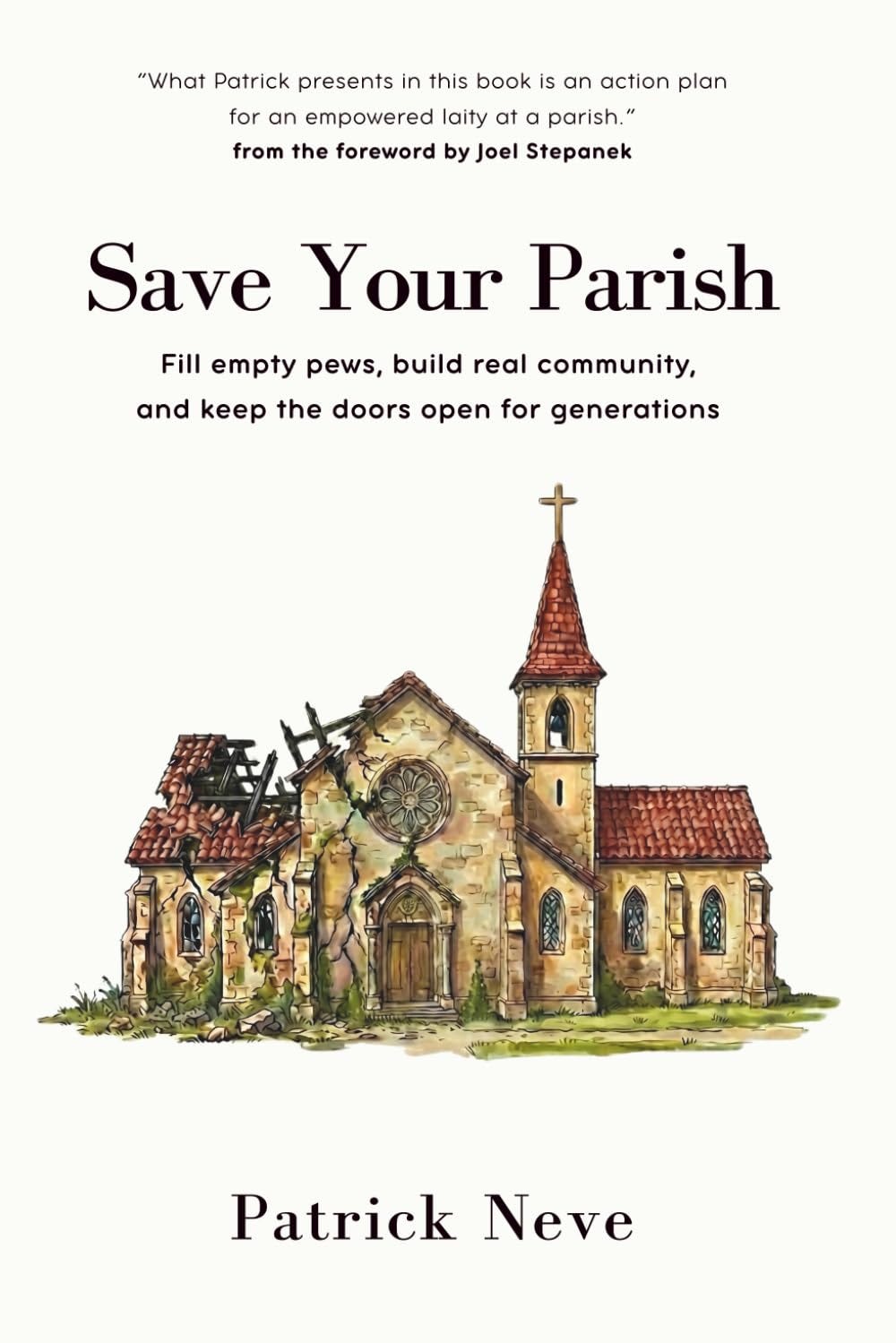
Our parishes can feel like that unfinished cathedral. Dilapidated. Abandoned. Hopeless. But the Church has always built in hard times. We’ve always thought in generations, not just years. We only have the church we’re given. This is the church we have. So let’s make the most of it. Let’s leave it better for our children and our grandchildren.
But before we can start building, we need to understand why we stopped. Why do parishes keep reaching for top-down solutions that don’t work? Why do laypeople feel like they need permission to evangelize their own neighbors? There’s something structural at work, something that happened after Vatican II that made things worse, not better.
It’s called Clericalism.
And that’s what we’ll explore next.
When our Pastor and the parish council wanted to revitalize our parish, we studied Rebuilt. We visited the Church of the Nativity and talked to the team. We attended Sunday Mass to see how they implemented all of the practices. On the way home, my wife and I discussed what we found. We agreed that, as vibrant as the church seemed, we couldn't find Jesus in it. The process worked for them and that is great but this was not going to work for our parish. Fortunately, our Pastor and the other council members agreed.
Instead, we followed the framework from Divine Renovation, particularly the admonition that the process takes time. At the beginning, you have to understand that you are working for a point, ten years in the future. It is very hard to stay with that plan, especially when your gains seem insignificant. Laying the groundwork to change the culture of a parish is hard work that takes time. Fortunately, our Pastor kept us grounded and focused until the change was unmistakable.
Our current Pastor inherited a parish that is vibrant and growing. One of the many things he is doing well is to really stress the sacred nature of the Mass celebration, bring back "the smells and the bells" that this new generation of Catholics (and many of us old folks) loves so much.
Where I pray this grows is one of the point you made that so many parishes get wrong. We have reduced most of our laity options for helping the community to making donations. Don't get me wrong; donations are great. When they are the primary means of parishioner involvement, you might as well fold your tents and go home. This is what I wish we would learn from our Protestant brothers and sisters. Our mission field is outside of the church. Whether we do organized service to the community or simply build a culture of going out to serve, the opportunities are plentiful and the fruit is so rewarding.
I have found the work of Fr. Michael and his right hand man, Tom C very helpful. But like most inspiring stories, they need translating to a local context. I found it illuminating to read the folks who inspired them. So I read a lot of Andy Stanley (part of the founding team for North Point) Rick Warren, and Bill Hybels (Willow Creek) to see what they were up to.
With them showing the way to a Catholic priest, I completely rethought how we might build ministry around the tent poles of hospitality, preaching and music. And I have seen incredible results and am delighted to see your expanding/challenging/growing similar insights.