


“Digital Missionary” is a trendy term in the Church right now.
The US bishops seem to be taking social media seriously, exploring how to evangelize through digital channels. Many have begun using this title to describe people who evangelize or discuss Catholicism online.
But framing “influencers” as “missionaries” is risky.
This term puts us at risk of missing the real goal of social media evangelization: connect the online world to the real world.
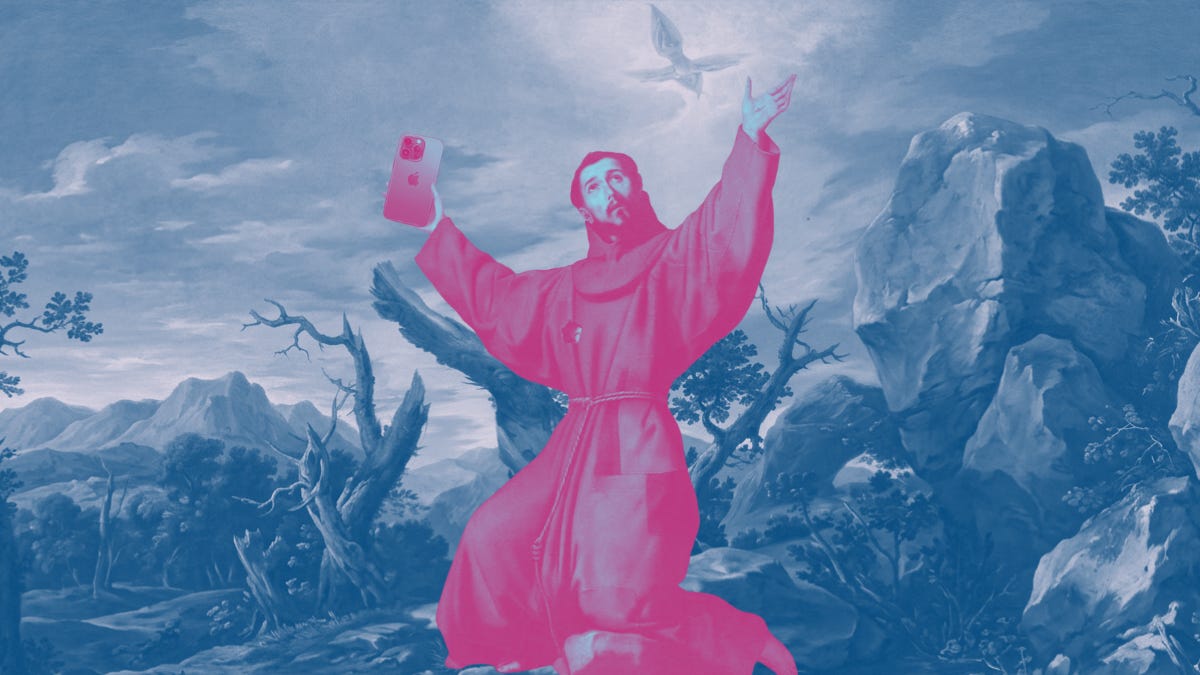
A missionary is not an influencer
Missionary work is a noble cause that comes with leaving your family behind and sacrificing for a foreign people. We should be careful comparing something as simple as posting on social media to something so heroic.
Social media, by its nature, is designed to make you focus on the things of this world: on power (influence), on fame (engagement), and on money.
Admittedly, those temptations are present in a mission field, too.
If you are a missionary to foreign lands, you can absolutely get hung up on the numbers—how many people are going to Mass, how many doors you knock on. You may get focused on how influential you are in the local community. You may even choose a mission field based on how wealthy the residents are.
But those temptations are baked into social media rather than being accidental.
If you succeed at digital content creation, you will have wealth, honor, and power you did not have before.
If you succeed at mission work…you might get martyred.
So we should be cautious treating the former as analogous to the latter.
The Anti-Missionary on the Digital Continent
The other risk with this framing is that it is a different kind of missionary work—if it is missionary work at all.
When the Spanish sent missionaries to the New World, those missionaries were not coming home. Their job was to bring the faith of Jesus Christ to the natives. In a certain sense, yes, that is what digital missionaries are doing.
But there is another important part of mission work which is not present in social media.
When missionaries went to a new place or a new country, they became citizens of that country. They stayed there. Like Saint Patrick, when he went to Ireland, he became Irish. He loved the people, lived there, and died there.
Digital missionaries do the exact opposite.
Digital missionaries go to the “digital continent.” But their goal is not to live here. In fact, you shouldn’t want to live here. The goal of a digital missionary is to get people off the digital continent and into real life. They are “anti-missionary” so to speak.
Pope Leo recently spoke about the danger of online Catholicism. It presents the danger of a “disembodied faith”—a faith that is not lived in the real world.
That is not a problem for real-world missionaries; they live and preach a very embodied faith.
But digital missionaries, if they are not careful, could be preaching a disembodied faith. It becomes an adherence to certain ideas or expressions of the faith, as opposed to the lived experience of a parish itself.
If they want to be truly missionary, digital creators need to connect the online world to the real world.
Build the highway to the parish
Catholic creators need to leave behind the mindset that what we are doing is good in and of itself. We need to recognize that our “missionary work” or “evangelization” is initial and temporary. It has to lead to something else.
That leads me to the big problem that we as a church need to solve.
How do we connect the digital continent to the parish?
I am afraid digital Catholic creators are focused on the wrong things. Most are excited when their numbers are going up, and they are reaching more people. But few consider what to do once those people are reached. All the talk about “bringing the faith to the unreached” means nothing if those people never darken the door of a Catholic parish.
True digital missionaries would make solving this problem their top priority.
There are plenty of people who want to create a YouTube channel, evangelize, and become the next big thing. But there are very few people who are trying to build the highway between the digital world and the parish.
Fortunately, even though that question does not seem to be at the top of everyone's mind, it is a priority for the bishops discussing social media.
What does that highway look like? A landing page, a directory, an in-person event? I have some ideas, but I don’t know.
So, I would like to know: if you converted to Catholicism from the internet, what was your highway? How did you get here?
If you’re a Catholic creator, you should apply to attend the Catholic Creator’s Conference in Steubenville from May 28-31.
Great article. As a lifelong subscriber to the Catholic influencer CatholicPat, unfortunately I think it's time for him to shut it down.
I think the digital mission field is important. We can influence the fence sitters. It’s the new town square. If we don’t have a voice, louder ones will.