


Many Christians think a “community” is “a group of people I agree with.”
But that could not be further from the truth.
Often, the people you fight with the most are those closest to you.
To paraphrase a quote from G.K. Chesterton: Christ called us to love our neighbor and love our enemy because often they are the same person.
We need to be in communities with people we disagree with.
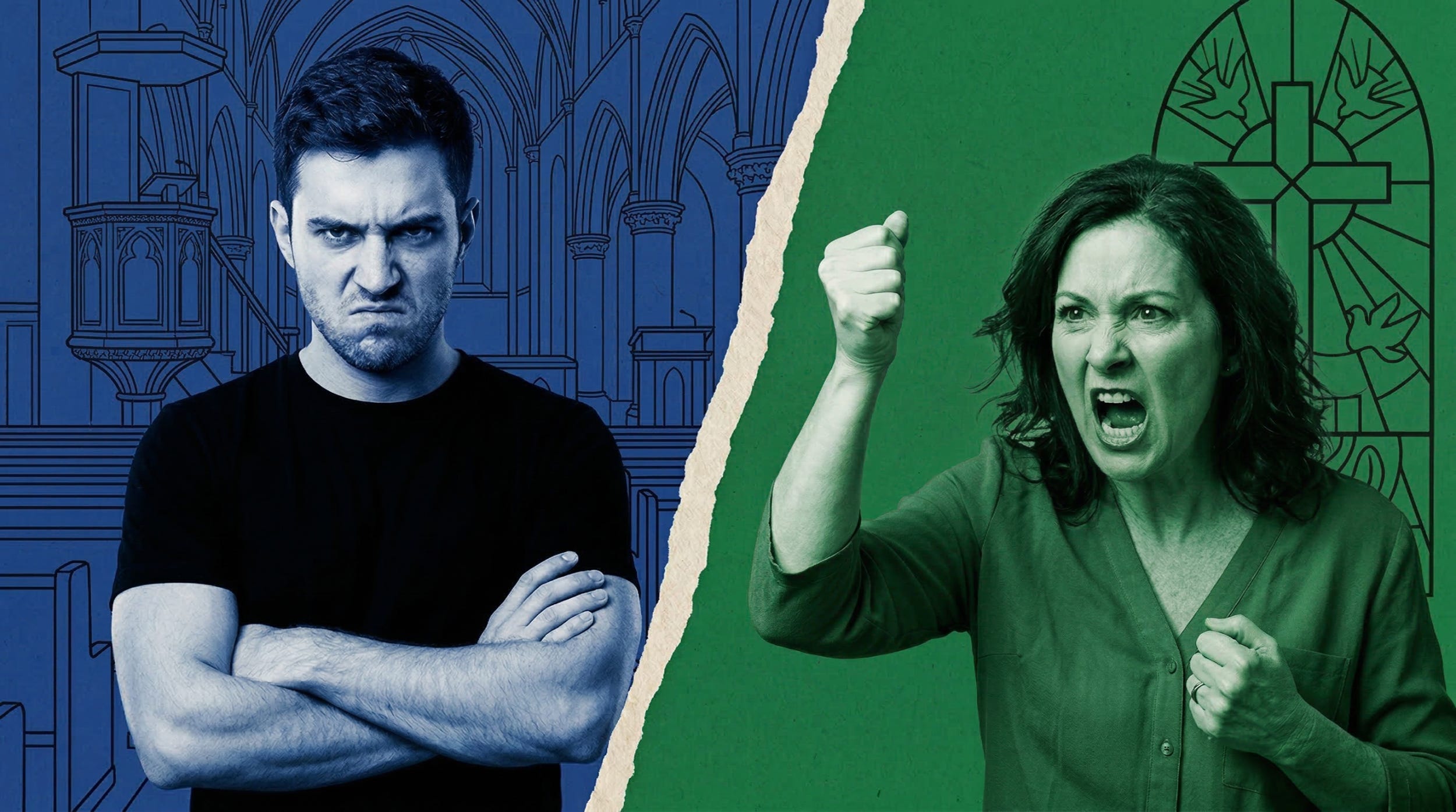
You might be wrong
A priest friend of mine once told me this belief that “community = people I agree with” is a distinctly lay phenomenon.
If you’re a priest or a religious, you are typically forced to be in community with people you do not get along with. You’ve both made the same vow, and that life is gonna put you in community with people that you didn’t choose.
You’re almost certainly going to live with someone you disagree with. That person might even be your pastor. So you might even have to obey someone you disagree with.
But lay people?
We have freedom of movement—more so than we’ve ever had in the history of humanity. We are able to remove ourselves from the people we don’t like.
But we are supposed to be with the people who disagree with us. Because it’s actually good for us.
Being around people you don’t like is an act of humility. It helps you remember you are not the arbiter of what is true, good, and beautiful. Sometimes the reason why we disagree with someone is that they are right and we are wrong.
You might be right
Even if you are right, dealing with people with whom you disagree (especially people in authority) is good for you.
Imagine a scenario where a traditional, faithful, conservative Catholic is upset a particular song is sung in the liturgy. Let’s say it’s Table of Plenty. A campy song that refuses to go away.
He knows this song is not fit for the liturgy. But the music director keeps playing the song. So what does he do?
Complain to the Bishop
Complain on Twitter
Email the director excerpts from Sacrosanctum Concilium every time it is played.
Go to a different parish (give up)
I’ve seen all of these solutions employed. They are all equally useless.
If this conservative Catholic wants to change anything, the actual solution is to become her friend (to love his enemy).
When he does this, he will find she has a different perspective. She knows people have grown up with this song and, for better or worse, have been spiritually enriched by it. She finds it enlivening, and it helps her focus on the Mass.
He will find she is pursuing the same good he is: a spiritually rich liturgy.
She is wrong in her means to that end. The music should change. But now that he is her friend, they can have conversations about their shared desire and disagree, knowing they have that shared goal in mind.
Make enemies into friends
You won’t correct someone by becoming their enemy.
You can only correct someone by showing yourself to be a brother.
A community is held together by communication. It requires at least two people who are able to have a conversation about the Good. Even if the perceived goods are at odds, community demands the presupposition that they both want the Good.
If we see our loved ones or our community members as enemies—as people who are deliberately acting contrary to the good—then we are siloing ourselves off. We’re causing division. We’re breaking the community apart.
You can’t actually have communion with someone that you believe to be an enemy. That’s why Jesus said if you’re going to offer sacrifice and you remember that you have a disagreement with your brother: stop, reconcile, and then offer your sacrifice.
Of course, assuming good intentions is difficult.
It’s frustrating to be the first one to listen because the other person might not be willing to listen in return. But Christian charity does not wait for a guarantee that charity will be returned. Christian charity acts first and willingly accepts any persecution that is returned.
If we want Catholic communities, we need to be willing to embrace the ugliness of conflict.
Community won’t be comfortable, but it will make us better.
Chapter 8 of my book Save Your Parish helps you deal with resistance (even from your pastor.)
Get your copy here:
My initial reaction was an outright no. But if you nuance your point more, I would be in agreement (not as if that’s what I should be aiming for, apparently!)
I wonder if it would be helpful to distinguish between a “church community” and a “neighborhood community”, and even then, we choose communities that we agree on the most important things. I chose my neighborhood because they all value family safety.
I choose to be Catholic and a part of my community because we agree (or ought to agree) on the most basic and important fundamentals of the faith.
Naturally we end up in communities we have disagreements with leadership, and if it’s on HOW or what to prioritize which requires prudential judgment, then that’s healthy. BUT if I’m in a community that ought to agree on the fundamentals, I wouldn’t say we need to be in those communities but that we should aim to be, like st paul said “of one mind”. So to recognize we won’t be in perfect harmony but that we should strive for it.
I don’t say this in disagreement but that I believe we should be specific about what kind of “community” and what kind of “agreement” we’re talking about.
And that's why we need to place podcasters under my authoritah!