


“Photini” is the traditional name for the woman at the well in John chapter 4.
I wrote this poem several years ago and it comes to mind every time John 4 is read during Lent.
I hoped to draw out the symbolism of the woman’s five husbands. In the 8th century BC, the Assyrians conquered Samaria and blended them with five pagan peoples, rendering them unclean to the Jews.
It is also an important symbol that the well belonged to Jacob. Both Jacob met Rachel at a well and Abraham’s servant found Isaac’s wife Rebekah at a well. So for an ancient Jew or Samaritan, meeting at a well has romantic undertones.
This subtext is important for understanding the interaction between her and Christ. That is why you will see parallels between the Gospel story, Song of Songs 2, and Hosea 2.
I hope you enjoy it. Please forgive any lack of sophistication in the poem.
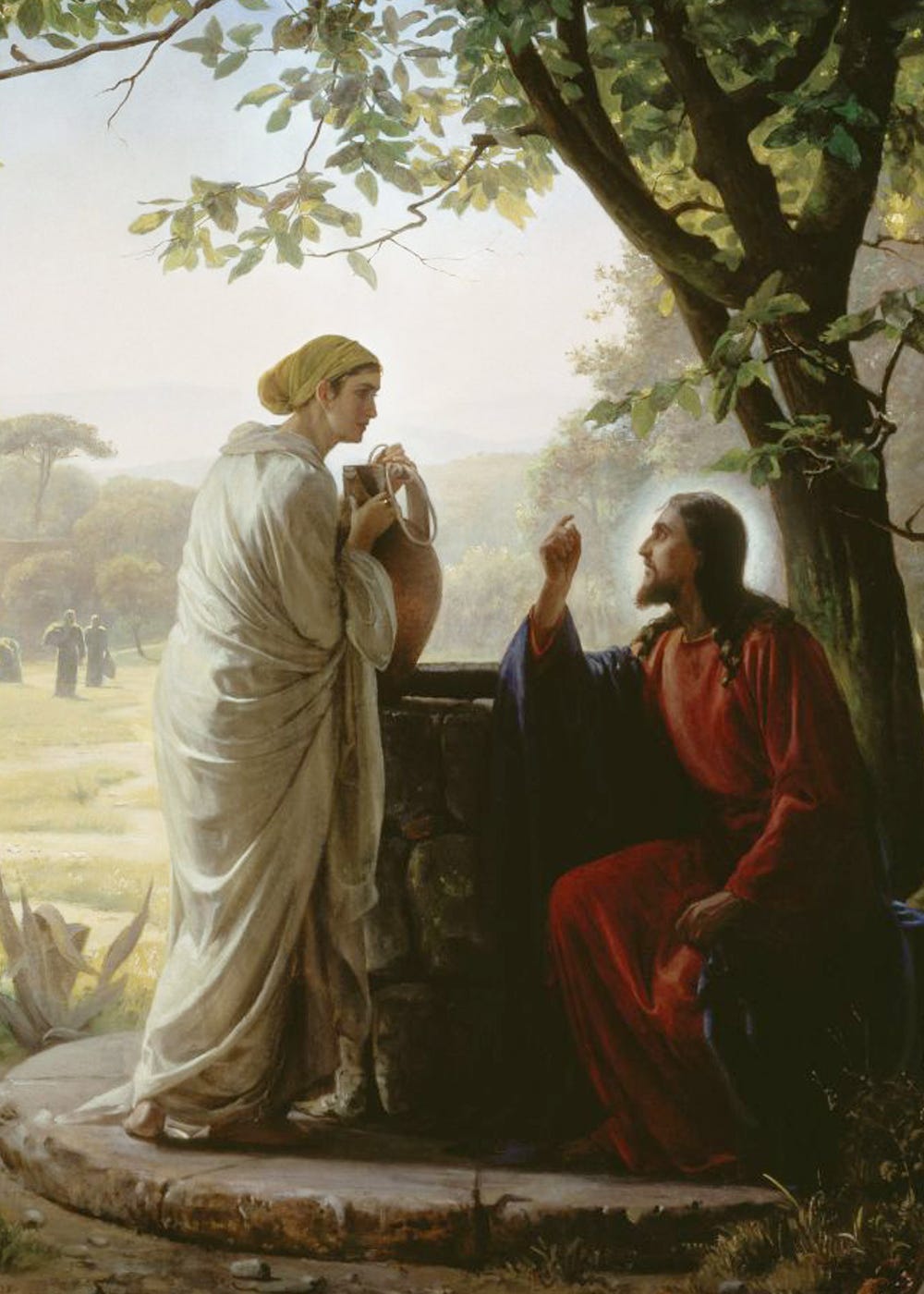
The briars and thorns my lovers gave,
I clung to for my food.
Through dry and weary land I walked,
to draw water at noon.

At first I did not see him there,
but then his eyes met mine.
His heart aflame with Jacob’s love,
beheld his future bride.

In dry land he spoke tenderly
about a living stream.
His words drew longing from my heart.
Could he give this to me?

He had no jar or vessel stone,
and though the well was deep,
he bore into my heart of stone,
poured water into me.

He knew my past, my people’s too,
whether coerced or free,
we pined after those foreign gods
and for adultery.

For I was wed to wicked men
and in desperate need
of a man like unto Moses
to come liberate me

“I know the Christ is soon to come
set Jacob’s children free.”
He looked at me with bridegroom’s eyes,
”Beloved, I am He.

“Winter is gone, the tulips bloom,
the doves begin to wing.”
I ran to tell my countrymen,
”He told me everything.”
I attended mass at the basilica in St Augustine, FL, this weekend, and this was the exact homily the priest gave. I had never heard about the parallels with the five pagan deities. Incredible.
Brilliant!