


Christians are called to be in the world but not of it.
But American Catholics have spent 60 years trying to make the world accept us instead.
It’s a trap. And it’s making us irrelevant.
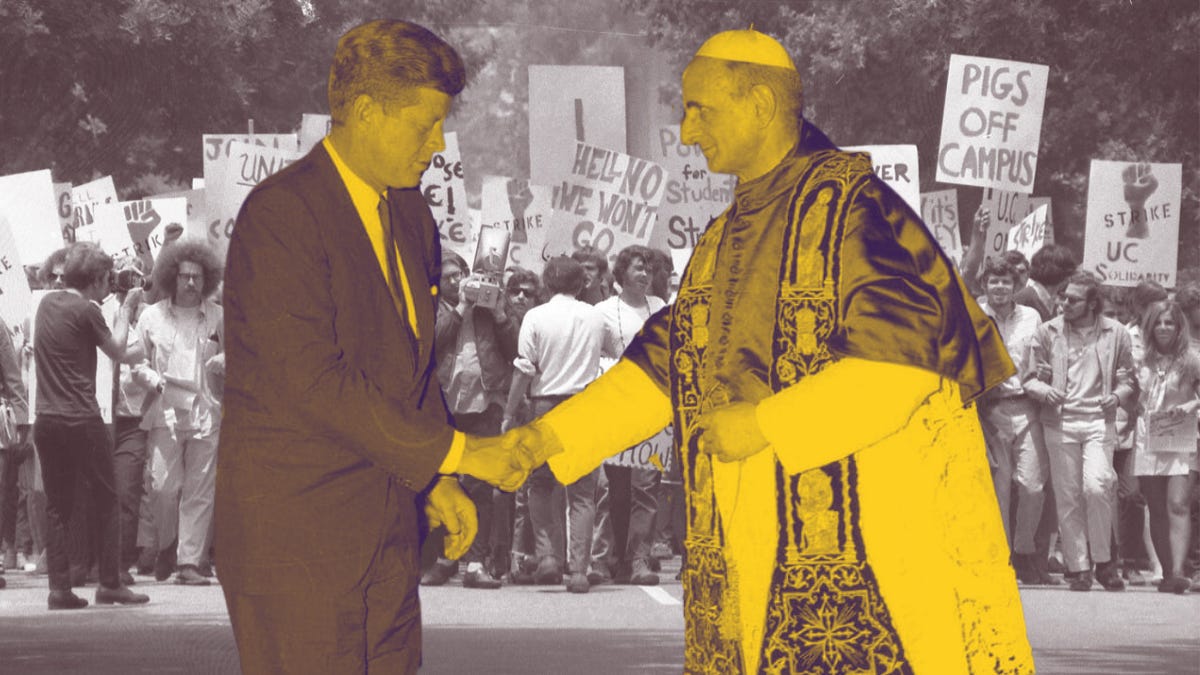
In the 1960s Catholics launched an aggressive campaign to prove we weren’t a threat to American social order. Since then, we’ve been obsessed with showing how compatible Catholicism is with modern values.
We wanted to prove we could be good Americans AND good Catholics.
But when you make Catholicism perfectly compatible with the culture, you make it unnecessary. Why become Catholic if we’re just like everyone else?
One example is Catholics adopting “social justice” language as if it is identical to Catholic social teaching. It is not. Modern “social justice” is rooted in Marxist class struggle. Catholic social teaching recognizes the legitimacy of class and the responsibility of the upper class, not its abolition.
Equality Is Not the Highest Good
Take equality. In America, this means either equality of outcome (if you’re a socialist) or equality of opportunity (if you’re a conservative).
Neither is Catholic.
Some go to heaven, some go to hell. That’s the definition of unequal outcomes. A complete meritocracy (equality of opportunity) ignores that some people can’t work to earn their own living. And they still deserve to have their needs met.
The Catholic answer is justice.
Justice means giving each person what they are due. That covers both the wealthy man who’s earned his rewards AND the severely mentally challenged person who deserves care despite being unable to work.
Justice requires knowing what a person is and what they’re owed. The Catholic Church is uniquely equipped to answer that because we know what man is and what his final end is: Heaven.
Elevate the Culture, Don’t Conform
Catholicism should look different in each culture because cultures have different values. Americans value freedom, bravery, class mobility, equality under the law.
Fine. Our Catholicism will express those values.
But not always the way Americans understands them.
John Paul II acknowledged America’s love of freedom was good. But recognized it was incomplete. Americnas understand freedom as “freedom from coercion.” But John Paul II defined true freedom as freedom for the good.
The Catholic Church elevates natural values to supernatural ones. We take America’s love of freedom and elevate it from “freedom from coercion” to “freedom for the good.” We take bravery and elevate it to fortitude and courage.
And then we eliminate what’s bad. We replace vague terms like “equity” with precise ones like “justice.”
That’s the Catholic approach. Acknowledge the good, then show how Catholicism makes it better.
Next time someone in a political conversation uses terms like “social justice” or “equity,” ask them to define it.
What is justice? What is equity? Is that the highest good?
Most people can’t defend these values because its like asking a fish to define water. The values are so self-evident they’ve never had to articulate them.
When they can’t, you can.
That’s when you offer something better. Not Catholicism conformed to American values, but Catholicism that takes what’s good in American values and elevates them to something higher.
Goodness is that which is desirable, according to Aquinas. What isn’t palliatable about this is that our own interior judgments need to conform to what is objectively desirable. The irony is that such a change is desirable only to the humble.