


Warning: This article includes content that some readers may find disturbing and that all readers will find cringe.
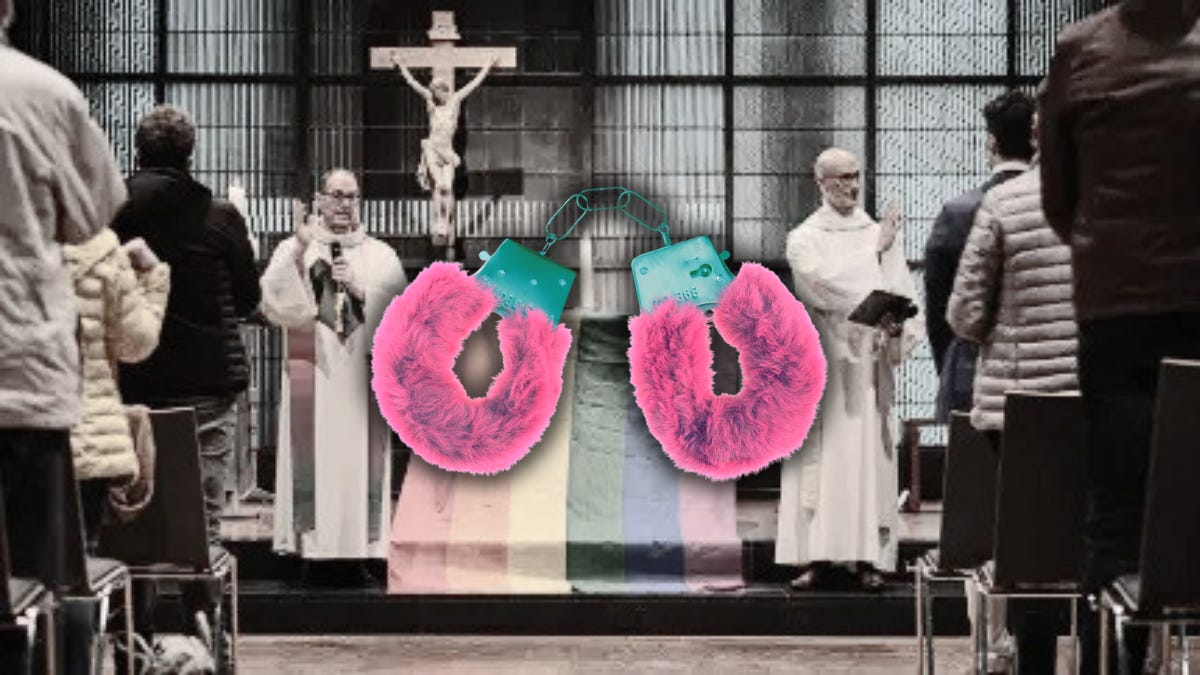
The German Catholic Church, in its ongoing effort to become the most ridiculous clown show in church history, has decided to allow a BDSM group to host a booth at its biannual Catholic Congress.
I wonder if the “congress” pun translates to German.
Anyway.
For those unfamiliar, the Katholikentag is a massive lay gathering of German Catholics, drawing tens of thousands of attendees and serving as an official showcase of where the German church sees itself going.
The organizers insist the group does not promote anything outside of Church teaching and that the point is to create dialogue with people of “alternative lifestyles.”
Let’s set aside the argument as to whether this kind of activity is in line with Catholic sexual ethics. Anyone with an ounce of genuine Christian love for their spouse will know intuitively that this kind of behavior is degrading and evil. I want to make a broader point about the state of the church in certain corners of the world, including our own.
Beige Catholicism, Naked and Afraid
The church is desperate, and has been for some time, to seem relevant and inclusive. I’ve written before about Beige Catholicism, an attempt to reconcile the Church to the ideals of the world. In doing so, it makes itself a bland, unnecessary, pointless parody of itself.
This BDSM booth is a perfect case study.
If the church is just as open to aberrant and disgusting sexual practices as the world is, if it confines itself to a purely consent-based sexual ethic, then why be Catholic? Catholic moral theology has always held that sexual acts must be unitive and procreative, ordered toward the good of the spouses and open to life. Strip that away, and you’re left with the same ethic as the secular culture: “as long as everyone agrees, anything goes.”
The Inverted Areopagus
Many in the Church succumb to the temptation of relevance. They preach “See, we believe what you do.” They look at what the culture values and rush to assure everyone that the church agrees.
This is the precise inversion of what St. Paul does at the Areopagus.
Standing before the Athenian philosophers, Paul doesn’t say, “See, we’re just like the Greeks. You worship an unknown god, and we worship an unknown god too.” He says: You worship an unknown god. I worship the God I do know: Jesus Christ. He points to the genuine good in pagan culture—their religious longing, their philosophical seriousness—and says the fulfillment of what they are searching for is fulfilled in Christ.
Paul elevates the culture to Christ. Beige Catholicism does the opposite.
Beige Catholicism sees the values of the culture and reduces the Church to those of the culture. It takes the secular world’s standard and meets it, rather than calling the secular world up to something higher. The German bishops aren’t “evangelizing the BDSM community.” They’re being evangelized by it.
Beige Catholicism’s Inevitable Absurdity
The Katholikentag was willing to host BDSM Catholics United or whatever as well as a panel discussion on why people seek assisted suicide. They were unwilling to host a panel on why people regret their abortions.
What we see in the German church is a reductio ad absurdum of what happens when you take this approach to its logical end. Eventually, you just become evil and disgusting. You start promoting sexual practices like sodomy and bondage, and downplaying real moral goods like the right to life.
This is what makes the German situation so clarifying. The “Synodal Way” machinery is more than willing to discuss whether you can tie up your wife, and whether you can kill yourself with the help of a physician, but is strangely reluctant to discuss why unborn children have the right to be born.
At first, this kind of compromise might appear to work. It keeps people from leaving, at least for a bit. It plugs the gap for a while, the way it did in much of American Catholicism for decades.
But if you continue to compromise with the world, you become indistinguishable from it. This is what the German bishops have done. They promote the same false gospel as the secular world and make themselves redundant.
They might as well take off their vestments. Their mitres are pointless.
What We in America Need to Avoid
Germany is a case study for what we need to avoid in the American Church. We need to reject and condemn the church leaders—and the parts of ourselves—that want to conform our Church to this world.
It is very tempting. Christianity, and certainly Catholicism, is not the dominant ideology of the day. It is tempting to want to fit in and live a secular lie. To trim the hard edges and make the church palatable to whatever the culture happens to be celebrating this year.
But we can’t do that. We have to resist it.
Otherwise, we will become depraved. We will not know the Lord, nor He us.
Death to Beige Catholicism

There is a certain type of Catholicism that has existed for the last 75 years or so.
I worked in a church before I became Catholic that had this attitude. Behind closed doors, we all knew what the pastors believed. In public, no mention of it because they didn’t want to hinder people coming to church. Eventually it filled with people opposed to any Christian teaching. It never works.
So many banger quotes to pull from this. Great job Pat!