


I went to Mass on vacation last weekend.
And as any Catholic can tell you, going to Mass on vacation is a mixed bag. One church will be perfectly reverent. But the next one has the children process through the pews singing “Jesus loves me” or the Eucharistic Ministers all wearing priestly stoles. If you pick a random Catholic Church for Mass, you never know what you’re going to get.
But it shouldn’t be that way.
The point of having liturgical norms is so the liturgy is celebrated in the same way throughout the world.
So why are there so many liturgical innovations and how do we stop it?
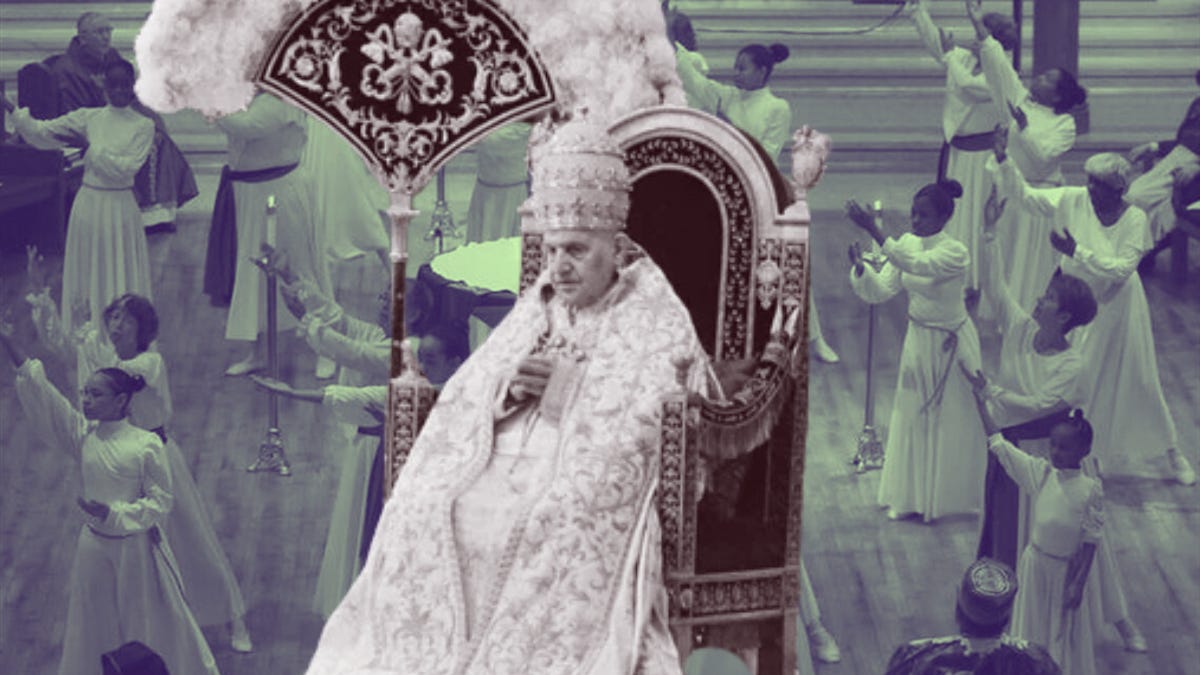
Naive Optimism
It’s easy to assume the people doing this are malicious, going for innovation for innovation’s sake.
But I don’t think that’s it.
I think they are infected with a naive optimism. They genuinely believe a little skit, a little dance, or a little prop will help people enter into the liturgy deeper. They don’t realize the damage it does
“But Patrick, why does it bother you so much?”
It doesn’t.
When I see an innovation in the liturgy, I just ignore it and move on. However, I’m not concerned about myself.
I’m worried about other Catholics in the pew.
These different experiences across Novus Ordo liturgies lead to symbolic confusion.
Symbolic Confusion
The Mass is catechetical. It is supposed to teach us about truths of the faith.
A Catholic who is well-versed in the Mass will know when something is novel in the liturgy and can just ignore it. But the less-catechized Catholic in the pew has no idea what is usually part of the Mass.
So added symbols have the potential to confuse younger or newer Catholics
One great example of this is from an organization that I like, LifeTeen
During the “Life Teen Mass,” they used to suggest the teens gather around the altar for the Eucharist. Their intention was to help the teens get physically closer to Jesus.
But what it did was it elevated them above the rest of the congregation in a way that didn’t fit the Mass.
That’s what happens when you innovate liturgy. You want to symbolize one thing, but it accidentally symbolizes something else.
We have thousands of churches all over the country coming up with strange pseudo-liturgical practices. When this happens, we obscure the symbolism that is supposed to be present in the Novus Ordo Missal as written.
The Solution: Rigid Adherence to the Rubrics
The only solution is rigid adherence to the rubrics of the Mass as written.
Say the black, do the red.
If we keep adding things, we won’t be able to see the effectiveness of the New Mass and if anything actually DOES need to change.
I think the reason why priests and parish members resist this is because they get tired of the symbolism. They are around it all the time. And so the symbolism doesn’t seem like it hits the same.
But the average Catholic in the pew is not around liturgy all the time.
The liturgist has been preparing for this for months. But this is the first time I’m seeing it.
If the point is for the people to enter in, just stick with the traditions that we have. There’s so much there. There’s no need to make anything else.
Rigid adherence to what is written also gives the priest a great way out when people inevitably complain.
I know of a young priest who was fighting against some of the innovations in his new parish. The parish didn’t kneel after the Lamb of God before communion. He said the rubrics say we kneel, so we kneel.
He found out that we didn’t have six candles on the altar. He said we’re having six candles on the altar because this is what the rubrics say.
And it was liberating.
It took the pressure off him and the community to “make things up” that “felt spiritual.” It lessened the blame, too. Don’t like something? Too bad, that’s what the missal says.
It doesn’t matter if people like it or not. This is what the liturgy is.
The liturgy is a tradition that people are being brought into. And eventually, it’ll affect them in some way. Over time.
Do we even have a Novus Ordo?
I don’t wanna blame this on the Vatican II because parish-by-parish innovation was not called for in Sacrosanctum Concilium.
That document called for the revision of the liturgy as a whole, but still expected uniformity. The Church expected to revise the Mass but in a way that would be followed. And we haven’t been following it.
We can’t even judge whether the Novus Ordo was a good development because we haven’t been doing it for 60 years.
I’ve been to parishes where they follow the rubrics more closely.and it’s beautiful. No one has home field advantage. Every Mass is being celebrated by a visitor, and so they follow the rubrics to the tee.
When parishes do this, the Mass is then a public universal expression of the Catholic faith. Regardless of even if you speak the language, you can still enter into the Mass because you know where you are.
Everything in the liturgy that the Church put together was focused on the sacrifice of Christ.
When we add stuff in it ends up making the Mass about us instead of about Jesus.
I spent several years as a diocesan liturgist, organizing the major celebrations (Chrism Mass, ordinations, etc.). The Master of Ceremonies I worked with and I came up with three simple standards when preparing a liturgy:
1) Trust the liturgy as it has been given to us by the Church.
2) Attend to the text, noting what it asks and what options it gives.
3) Make choices that will help the people (bishop, ministers, assembly) worship well together.
I can't say we did everything perfectly, but these points helped us immensely in our roles serving the Church.
The problem is that you assume the Catholic tradition is simply "doing the red, saying the black," a sort of legal positivism that is antithetical to the faith. We need to admit that there are numerous Novus Ordo masses that are ugly, irreverent, and disastrous to the faithful yet still technically following all of the rubrics. That's because not only does the Novus Ordo allows over 3 million variations, but the very narrative of rupture that forbids the TLM means every priest (even the well-intentioned ones) have to figure out what reverent means for their parish. You cut yourself off from the tradition, you have to start figuring things out on your own.