


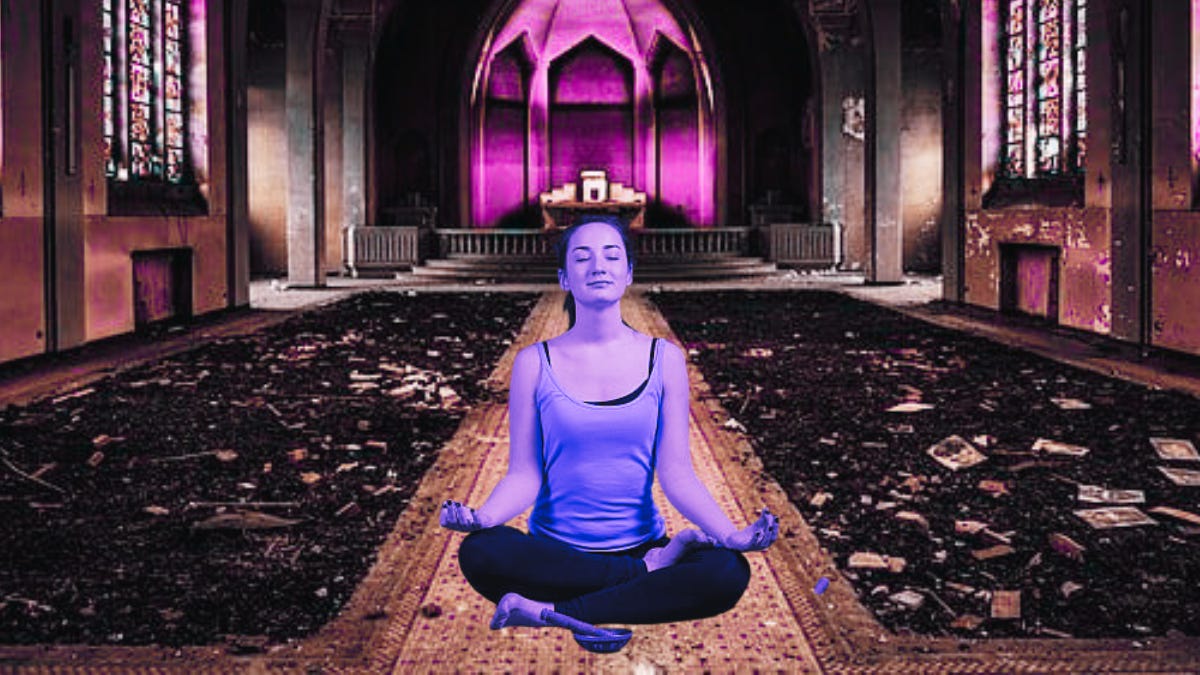
A recent op-ed in Religion News Service offered a refreshing moment of moral clarity from the Spiritual-But-Not-Religious crowd.
Liz Bucar—a professor of religious ethics at Northeastern University who has written a book on the subject—admits that the “spiritual but not religious” (SBNR) have traded in something essential and are now dealing with the consequences.
According to Bucar, they have lost a sense of community and the obligations that come with it. The things, in other words, that religion actually provides.
She notes that SBNR folks have looked for meaning in meditation and yoga, in run clubs and wine tastings, and Sunday morning brunches that have quietly replaced Sunday morning Mass. But these things don’t fulfill what religion did. Her proposed solution is that the SBNR needs to recover obligations by making intense commitments to one another within these new structures.
I appreciate the honesty of the diagnosis. Her solution, however, is impossible by definition.
You Cannot Manufacture What You Discarded
The problem is that her thinking is classically liberal.
She assumes that the structures of religion—belonging, obligation, mutual duty—can be willed into existence through free association. Find some like-minded people, commit to one another, and presto: community.
The fact is, they lost these things because they lost religion. These are inherent to religion. You cannot have them without it.
You cannot have a sense of obligation without religion or family. You cannot have true belonging without a totalizing worldview that makes claims on every part of your life. A run club doesn’t do that. Yoga doesn’t do that. They all assume you remain the sovereign of your own life, dipping into these activities for personal benefit.
This is why these things naturally exclude what the author is looking for. Her religion—because make no mistake, it is a religion—is liberalism, the conviction that autonomy is the highest good.
What does it mean to be spiritual but not religious? It means that the spiritual experience is yours. It’s something you generate within yourself, on your terms, with the parts of traditional faith you happen to like and none of the parts you don’t. It is a thinly veiled worship of the self. And because that is the case, it will naturally prohibit you from the kind of spiritual communal life enjoyed by religious communities. The isolation is a consequence of the SBNR lifestyle.
Self-Actualization is Self-Defeating
There is something deeper going on here, and I think it gets to the heart of why these communities can’t be manufactured.
The entire SBNR project is built around self-actualization. The only thing that unites people in a yoga studio or a run club is a shared, vague interest in becoming their best selves. Which means by definition that the moment another person stops serving your self-actualization, they can be discarded. The relationship has no foundation beyond mutual use.
This is precisely not what happens in a church or a family. The people in your parish, the people in your family, are given to you by God. They are your duty. You don’t get to leave them because they’ve stopped being interesting.
Here is the paradox of the Gospel that the SBNR worldview cannot grasp: Man only finds himself through the gift of himself.
The spiritual-but-not-religious are seeking to find their lives. And they will lose them. The thing they are looking for—meaning, belonging, peace, integration, the experience of being fully alive—is on the other side of the surrender they refuse to make.
If they took up religion, they would have to give up the self, the thing they care about most. But they would finally find the thing they have been chasing.
Are we ready for them?
What’s encouraging is that spiritual-but-not-religious people are, as this author admits, seeking. They want the things they discarded, and they’re starting to notice the absence.
People like this author—who reject organized religion a priori, without ever really experiencing it—will be hard to convince. But there are plenty of others who left religion behind, who realize now they were wrong, and who are ready to come home.
The question is whether we will be ready for them.
Strengthening our communities is, more than anything else, a matter of mindset. It starts with seeing your parish as your extended family, not as a club you joined and could leave if a better one popped up across town.
I write about this in my book, Save Your Parish, but the core of it is simple: until we view our parishes the way we view our families, we will never build the kind of community that can catch the spiritual-but-not-religious when they finally come home.
The seekers are coming, so let’s make sure there’s somewhere real for them to land.
»»» Get Save Your Parish or read the first chapter below.
How the average lay person can save their parish

Below is the first chapter of my book, Save Your Parish. The book launched on February 2 of this year and hit #1 on Amazon in Catholicism. Get your copy here.
This is incredibly well said! I agree completely, people will always have a hole in their lives that only religion can fill because religion is the only thing left willing to enforce sovereignty over the individual