


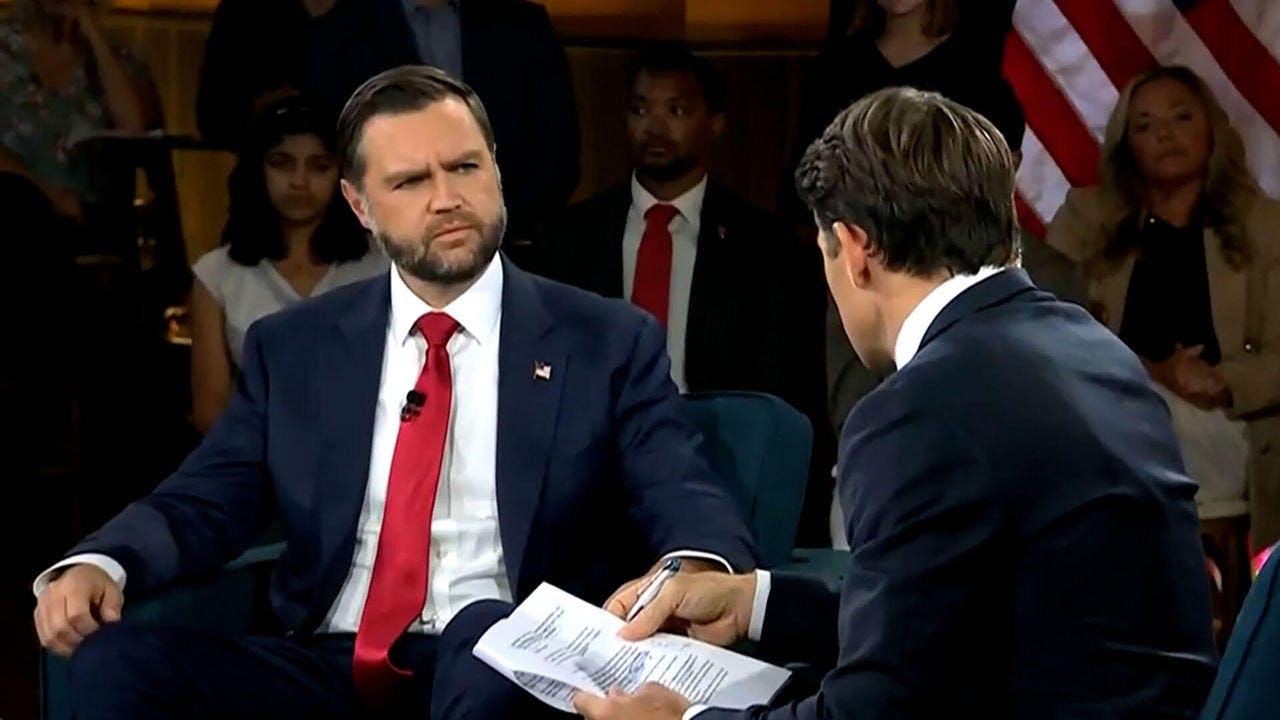
At a CBS town hall last week, Sister Nancy Sylvester of the Sisters Servants of the Immaculate Heart of Mary asked JD Vance about ICE activity, compassion, and treating people with human dignity. Vance responded by saying the administration is trying to “balance law enforcement with humane law enforcement.”
While understandable, this is the wrong framing for the issue.
We don’t need balance on immigration. We need justice.
The Snuck Premise
To Vance’s credit, his instincts on immigration are usually right, and I’ve defended him here before. This isn’t a case of a bad position, but a case of a bad frame. To be fair to the sister, her concern for the dignity of migrants is a genuine Catholic concern, and she was right to raise it.
The sister’s question included a snuck premise, and Vance’s response granted that premise – namely, that enforcement inherently involves cruelty. Law enforcement, even when violent, does not inherently involve cruelty. Force is sometimes necessary to justly enforce the law. Just as it is sometimes necessary to use force in self-defense, it is sometimes necessary to use force to enforce the law if it’s necessary. God willing, such violence is not necessary in a specific case, but in general, it typically is.
Since force in many cases is morally necessary, we cannot call it “cruel,” since cruelty is never necessary.
We Don’t Put Dogs on Trial
There’s no contradiction between enforcement and human dignity. In fact, enforcing the law itself is respecting human dignity.
We don’t sentence a dog to prison time for biting someone. We might put it down, right? But we don’t ascribe moral fault to a dog, something that has no reason. But we do ascribe moral fault to a human being when they break a law, because breaking a law is an act of free will.
This is the oldest definition of justice we have. Thomas Aquinas, following the Roman jurists, defines justice as “a constant and perpetual will to render to each one his due” (Summa Theologiae II-II, q. 58, a. 1). And so by giving someone their due, the due punishment, we are affirming that they made a rational choice and have human dignity.
Justice doesn’t compete with dignity, but presupposes it.
The Politics of the Ideal
The frame that our society works under is what I call the Politics of the Ideal, which sees politics as two ideologies battling out in the “marketplace of ideas.” The hope is that those two ideologies will find some kind of balance in the middle.
Catholic politics, on the other hand, is the Politics of the Real, a phrase I’m borrowing from the philosopher D.C. Schindler. Distinct from the ideal, the Politics of the Real is a common quest for what is true and just, independent of a priori ideologies. It is a “conversation between friends”; citizens of the city working together to find what is true.
So the response should not be, “We’re looking for balance on immigration.” It should be, “We’re looking for justice in immigration.” Justice is something that is neither excessive nor deficient in its enforcement. In each case, and in immigration policy generally, there is justice to be done, and we need to find out what that justice is.
We should not ask how much justice we can trade for compassion, but ask what justice requires.
What justice must be done?
The sister’s concern over cruelty is understandable, as the most gruesome stories of ICE raids are plastered over left-leaning news sites and social media whenever they happen. There’s no use trying to litigate these here one by one. Suffice it to say, the volume of deportations under this administration makes these kinds of encounters inevitable, and these cases [often] have aggravating circumstances that justify the force.
It seems to me the cruelty is not the issue but the volume of deportations. Many Christians who have a good and admirable compassion for migrants are uneasy over the volume and ask why it is necessary.
The volume of deportations is just in proportion to the volume of illegal immigration that has taken place in this country over the last few decades, encouraged by both the left and right.
It is true, as many argue, that America is wealthy enough to support a good number of migrants who need our aid, especially from our neighbors in South America. However, the volume of recent years - a record 3.5 million added to the unauthorized population in just two years, from 10.5 million in 2021 to 14 million in 2023, according to Pew Research Center - is unsustainable. Our welfare system, part of the entitlement spending driving our ever-growing national deficit, is not large enough to support the 59 percent of households headed by illegal immigrants that use at least one major welfare program, mostly through their U.S.-born children, according to the Center for Immigration Studies.
The volume also makes it harder for these groups to integrate, which the Catechism names as a duty of immigrants: they are “obliged to respect with gratitude the material and spiritual heritage of the country that receives them, to obey its laws and to assist in carrying civic burdens” (CCC 2241).
Given our current situation, a high volume of deportations and heavy restrictions are necessary as remedial measures to fix our broken migration system and protect our nation’s wealth for our children and grandchildren, to whom it will be passed on.
What Bl. Fulton Sheen called "false compassion" seems to be driving this narrative for many Catholics today.
Well said. The hierarchy has mostly forgotten the need for balance and justice in this matter and ignores the common good of the indigenous people. Their position amounts to a degradation of the conditions of the working class.