


The Pope’s favorite movie is usually a meaningless question asked by journalists.
But Pope Leo’s answer revealed something interesting about his papacy.
It telegraphed his deep commitment to the common good…
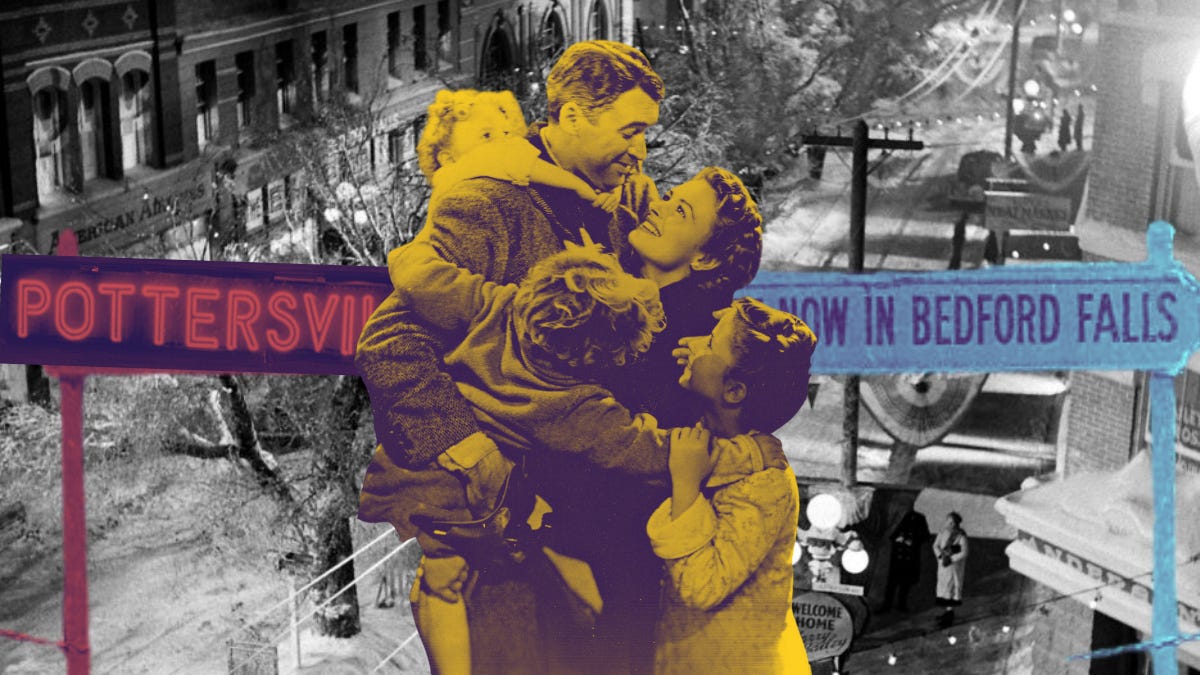
Pope Leo said in an interview that one of his favorite movies is It’s a Wonderful Life.
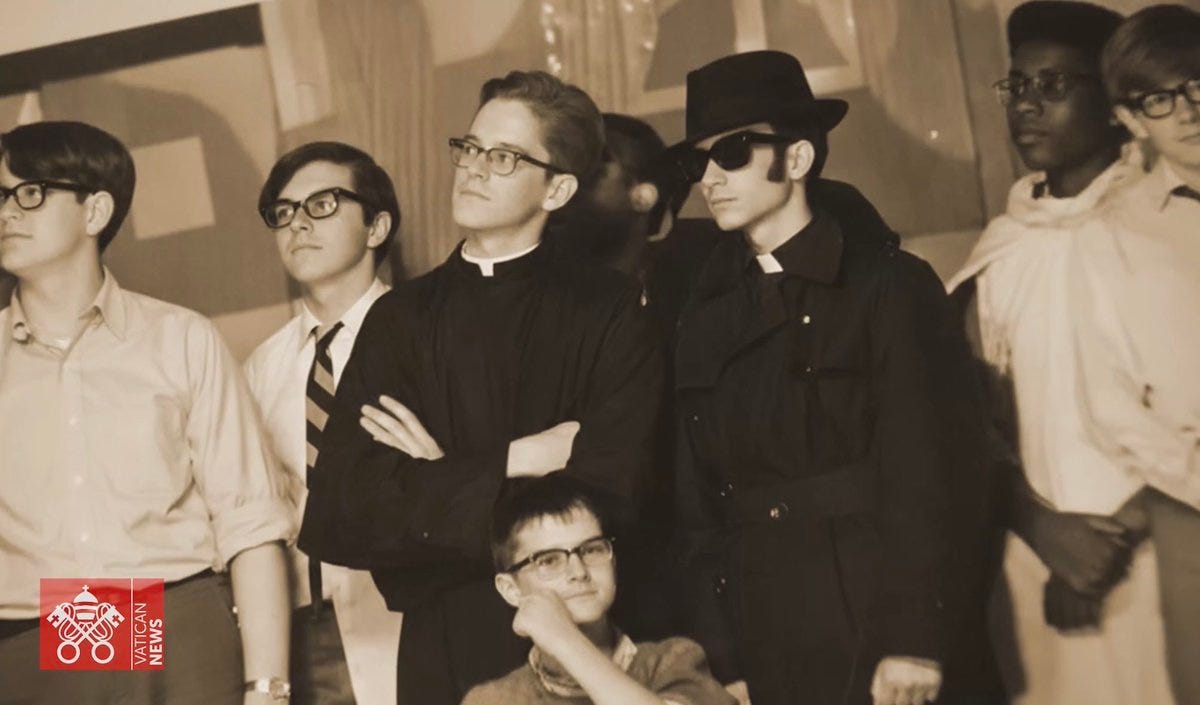
Now, I didn’t believe him at first. He was in seminary in the 80s when some of the best comedies of all time were released. He dressed like a Blues Brother in 1984. So I definitely think that movie is in his top 4 at least.
But I was wrong.
Because (I have to admit something embarrassing) at 28 years old, I’d never seen It’s a Wonderful Life. I’d only seen the last 15 minutes where George Bailey sees what his life would have been like if he had never been born.
And if you don’t see the first two hours, those last 15 minutes don’t really hit as hard.
So this Thanksgiving, I made it a point to sit down and watch the whole thing
And during the movie—I got it. Now I think this movie should be mandatory viewing for every Catholic at some point in their life, especially during Leo’s papacy.
Because It’s a Wonderful Life is about Catholic Social Teaching.
The Economics of Bedford Falls
George Bailey runs the family business, the Building and Loan. They lend money to families so they can own their own homes and pay off loans over time. It’s not a profitable business—presumably because they’re not taking usurious amounts of interest for these loans.
The villain of the movie is the archetypal capitalist, Mr. Potter.
He owns everything in town except for the Building and Loan. Throughout the movie, Potter tells George that the Building and Loan doesn’t make business sense. It doesn’t make sense for him to lend to people who can’t afford it.
It’s a Wonderful Life contrasts a man who pursues his own self-interest (Potter) and a man who pursues the common good (George).
At first, it seems like Potter is right. All of George Bailey’s generosity has led him to live in destitution. Potter is only getting wealthier.
But the movie’s key lesson is about long-term effects.
When the Great Depression starts, George Bailey puts his honeymoon on hold. The townspeople tried to pull money from their stock in the Building and Loan. But George knows if they all do that, the Building and Loan will go bankrupt, and all of their homes will be foreclosed on.
The townspeople need cash for the week, but their actions would have put them out of a home in a year. By acting in their own short-term self-interest, the townspeople were actually working against their own long-term self-interest.
George saves them by acting against his own immediate self-interest to save the common good. He starts giving out his honeymoon savings to people—not out of charity, but as loans—so he can keep the Building and Loan open.
Potter finds this ridiculous.
But years later, at the climax of the movie, when George loses $8,000, all of those people come back. They not only cover his $8,000 debt—they exceed it. His friend Sam sends him $25,000, and people are still pouring in, giving him money. He presumably made back four times what he lost.
Catholic Common Good
Pope Leo probably loves It’s a Wonderful Life because of how it promotes the Common Good, a key principle of Catholic Social Teaching.
The “common good” is the set of conditions in a community that help people to flourish, both individually and together. (see CCC 1906)
When a man pursues the common good, like George, he sacrifices in the short term. But since the common good is stronger, the community can support him if he fails in the long term.
When a man pursues his own self-interest, like Potter, he eventually destroys the common good. Without George, Bedford Falls turned into Pottersville, a den of drinking, gambling, and sin. He seems to be profiting in the moment, but when (not if) Potter fell on hard times, that community would not be the kind of community that could support him.
We often feel motivated to pursue our immediate self-interest rather than pursue the common good, much like the townspeople trying to withdraw their money.
But if we do that, we are harming ourselves in the long term.
It takes heroic virtue to be like George Bailey and act against immediate self-preservation to help the common good. So we as a Church need to be that heroic person.
Pope Leo knows this.
His recent exhortation Dilexi Te addresses poverty as a personal and local problem, not just a practical or national problem. He says aid to the poor must treat them as subjects—as people, members of our community—rather than merely objects of our giving. We need to lift them up out of their poverty and make our communities stronger. And that can only happen when you know them.
That’s exactly what George Bailey does in the movie.
The world is full of Mr. Potters trying to get rich off of technological developments, squeezing every last cent out of the working man. There needs to be a force in this world, in our country, in our communities, that helps people build sustainable lives for their own sake, out of love for them, not out of a desire to make a quick buck.
Those people are few and far between.
But we should at least be able to find them in a Catholic Church.
Pope Leo’s "Dilexi Te" Challenges Both the American Left and Right

Pope Leo XIV released his first apostolic exhortation, Dilexi Te, which continues Pope Francis’s focus on the poor.
This is so well done and spot on… There are so many Mr. Potter’s in the world and we are meant to be the counter agent… An invasion force for the Lord Jesus bringing Hope or redemption. It always baffles me that we are the redemption plan