


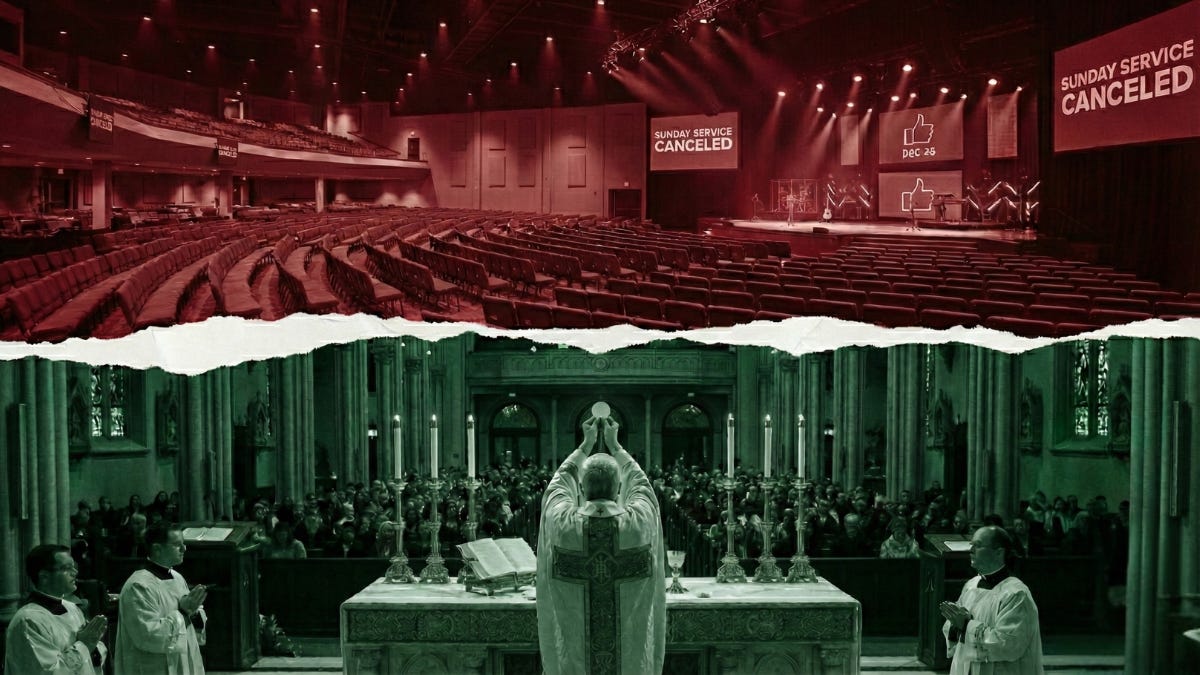
Life Church, one of the largest megachurches in the country, canceled Sunday services this week.
Christmas fell on Thursday. Attendance is always low the Sunday after a holiday. So they just... didn’t have church.
This isn’t new in megachurch world. I once read a leadership book by a megachurch pastor who bragged about canceling services on Memorial Day weekend. His reasoning? The Bible doesn’t say you have to go to church on Sunday.
He’s right. It doesn’t. But we still have an obligation to go.
Modern Christianity has lost the concept of obligation. We talk endlessly about what God has done for us. We rarely talk about what we owe Him in response.
But that’s a question of justice.
Justice means giving someone what they’re due. And worship is a subset of justice. It’s what we owe God. He gave us existence, he redeemed us, He gave us heaven. So what do we owe in return?
Everything.
At minimum, we owe Him an hour on Sunday.
The Catholic Church has a robust understanding of obligation and this is reflected in how we celebrate feast days. Christmas is a holy day of obligation. So is the Solemnity of Mary, Mother of God, one week later. And if Christmas falls on Thursday, guess what? You still go to Mass on Sunday. And the next Thursday.
The liturgical calendar teaches us about God. Holy days of obligation teach us what we owe Him. When the Church says “you must come to Mass today,” she’s saying: what we celebrate today is so important that we have to be together.
Christ’s birth demands our presence. The Lord’s Day demands our presence. The obligation itself proclaims the importance of the feast.
But Patrick! That sounds like legalism! Christianity is about grace, not rules.
Obligation and grace aren’t opposites. Grace is what God gives us. Obligation is our response to that grace. A marriage has obligations. A friendship has obligations. Any real relationship does.
A Christianity without obligation is a Christianity without relationship.
One way to think of holy days of obligation is as a tithing your time.
Money controls our lives. We like having control over it, but it ends up controlling us. Tithing breaks that hold. It reminds us that our money belongs to God.
Holy days of obligation do the same thing for our time works the same way. We guard our schedules. We resent interruptions. We act like our time is our own. But holy days of obligation interrupt that illusion. They stop your business. They disrupt your schedule. They say: God owns my time.
You don’t have to feel grateful in the moment. You don’t have to want to go. But when you show up anyway, you hear the readings and receive the Eucharist, you remember what really matters. You receive a gift you wouldn’t have gotten otherwise.
If a Catholic parish canceled Christmas Mass, it would be a scandal. If we canceled the Sunday after Christmas, same thing.
But when a Protestant megachurch does it, we shrug. We’ve accepted that their tradition simply doesn’t have the category of obligation.
That’s the real scandal. Not that Life Church canceled services, but that American Christianity has drifted so far from the ancient faith that canceling worship doesn’t even register as a problem.
Obligation is a gift. It’s how the Church teaches us to love God with our whole lives, not just when it fits our schedules.
I came into full communion with the church this past Easter. The majority of my family of origin is Protestant of the non-denominational variety. They all debated whether or not to attend church this past Sunday because small group classes weren’t meeting, the number one and number two pastors weren’t preaching (I think option #4 got the job) , they can just watch it at home etc. I happily went to my parish Sunday morning. The church down the road from me had a sign saying no in person services this weekend
The scandal of COVID was that the bishops DID cancel Mass for many Sundays in a row. It was almost a pinch of incense burnt for the emperor's lockdown.