


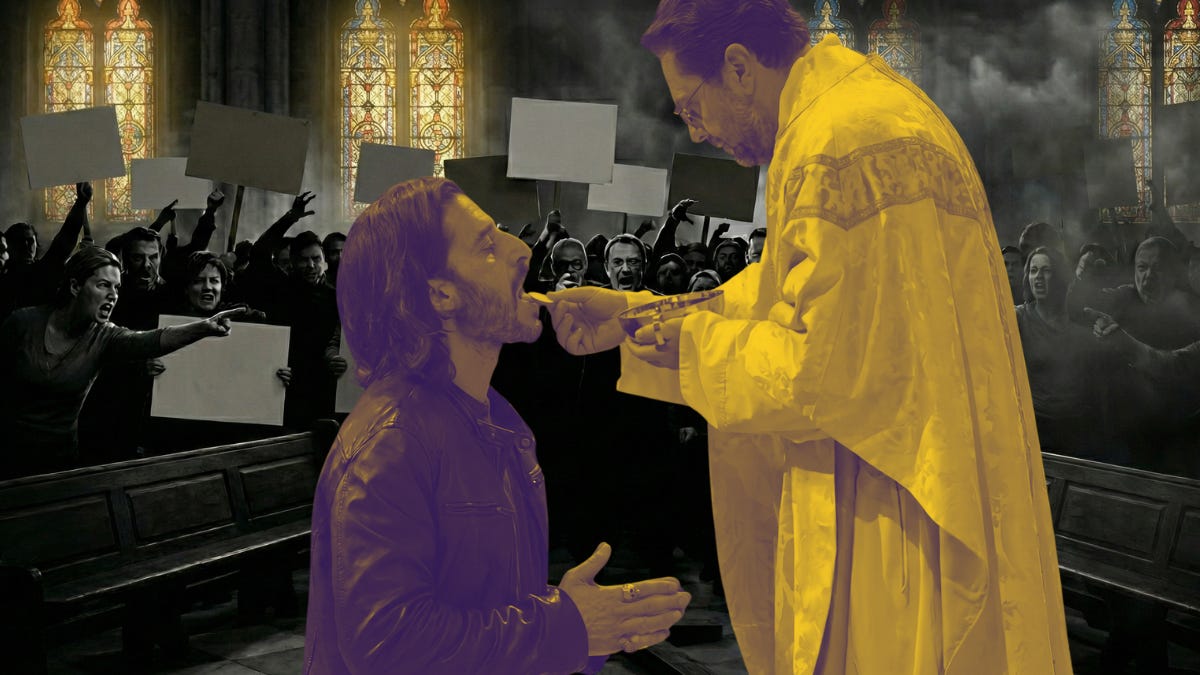
Jonathan Roumie loves the Eucharist.
He’s spoken about it at the National Eucharistic Congress, led processions through Times Square, and tries to receive reverently on the tongue while kneeling.
But in a recent interview with Fr. Mike Schmitz, Roumie shared that once, after kneeling to receive, he was asked to stand up.
The guy who plays Jesus was told his reverence wasn’t welcome at Mass.
And that tells us something uncomfortable about how we treat reverence in the American Church.
The Piety Police
This happens more often than you’d think.
Years ago, I knelt to receive during Mass, and the priest asked me to stand. I complied because I was embarrassed and didn’t want to make a scene. But I was frustrated. I had been silently praying, and now suddenly the focus was on me.
Which is ironic.
The accusation levied against people who kneel for communion is that they are doing it for attention. But I wasn’t kneeling to be noticed. Neither was Jonathan. I was kneeling to pray. The priest who called me out ended up drawing attention to me.
This is the absurdity of policing piety. The cure is worse than the disease. You’re worried someone is being performatively reverent, so you... publicly correct them during the most sacred moment of the Mass?
And what bothers me the most is that the policing is wrong.
The General Instruction of the Roman Missal says standing is the normative posture in the United States, but it also says no one should be denied communion for kneeling.
The norm established for the Dioceses of the United States of America is that Holy Communion is to be received standing, unless an individual member of the faithful wishes to receive Communion while kneeling. (GIRM 160)
The Congregation for Divine Worship explicitly condemns denying people the right to receive while kneeling.
It is not licit to deny Holy Communion to any of Christ’s faithful solely on the grounds, for example, that the person wishes to receive the Eucharist kneeling or standing. (Redemptionis Sacramentum 91)
The Code of Canon Law 915 does say people in who “obstinately persist in manifest grave sin” should be denied communion. And yet in America, you are more likely to be denied communion for kneeling than for cohabitating with your boyfriend or being a pro-choice politician.
We would deny communion to people who might be prideful, but happily give the sacrament to people who are clearly living in grave sin.
We’ve inverted our priorities.
Why people really care
But here’s what I think is really going on.
I don’t think people are being knowingly hypocritical or that anyone is anti-piety in general. I think something deeper is going on.
When someone kneels to receive communion, it convicts people. Some feel inspired, which is what happened to me. I saw people I respected kneeling, and I thought, “That’s beautiful. I want to be more reverent too.”
Others feel threatened. The conviction gets misread as judgment. “What, you think you’re better than me?”
People get upset when someone kneels because they think the person kneeling sees themselves as morally superior. That’s usually it.
To which I’d say: Who cares?
Even if they did think they were morally superior—which they probably don’t—you can’t control what someone else thinks. What you can control is your own reaction. And if your reaction to someone else’s exterior reverence is anger, that says more about you than them.
To Fr. Mike’s credit, he affirmed in the interview that Roumie has every right to kneel. And Roumie reflected on whether he was doing it for the right reasons, which tells you his heart is in the right place.
All the more reason he shouldn’t have been corrected in the first place.
So here’s my takeaway from this: It’s useless to worry about someone else’s piety.
If you are worried about whether someone’s piety is false…stop. You can’t search someone’s heart. You can’t know if their reverence is genuine or performed. And even if you could know, what exactly is your plan? Force them to be less pious?
This is all vain and fruitless.
People who are alive today grew up kneeling to receive communion. Surprisingly, this practice is a source of disunity in the Church. It just makes certain Catholics feel unwelcome.
Let people be pious and worry about their own hearts.
I was denied communion for being on my knees once. Priest literally shrugged, shook his head, and stepped to the side so the person behind me could receive while I stood up. Not wanting to make a scene (and planning to talk to the priest later), I just stood up, opened my mouth, and again got the shake of the head as the priest gestured for me to receive in the hands. Chatted with him later and he was perfectly cordial about it, but claimed some diocesan guidelines that were obviously nonexistent. Really weird.
I once got a deer-in-the-headlights look from an older priest when I knelt and presented my tongue. He didn't chastise me or explicitly deny me, but I immediately gave him my hands instead and he looked relieved. I've never been one to insist on kneeling/tongue anyway.
Nowadays, I'm most likely to go kneeling/tongue when I happen to be carrying my infant son while I receive. At that point it's a much easier maneuver than trying to receive in the hands whilst holding a baby. Far less likely to drop the host (or the baby).