


Last week, the Trump administration released aliens.gov, a website built around a 1950s sci-fi theme that compares illegal immigrants to alien invaders from outer space.
It’s a silly joke and another chapter in the ongoing story of our politics becoming more about memes than governance.
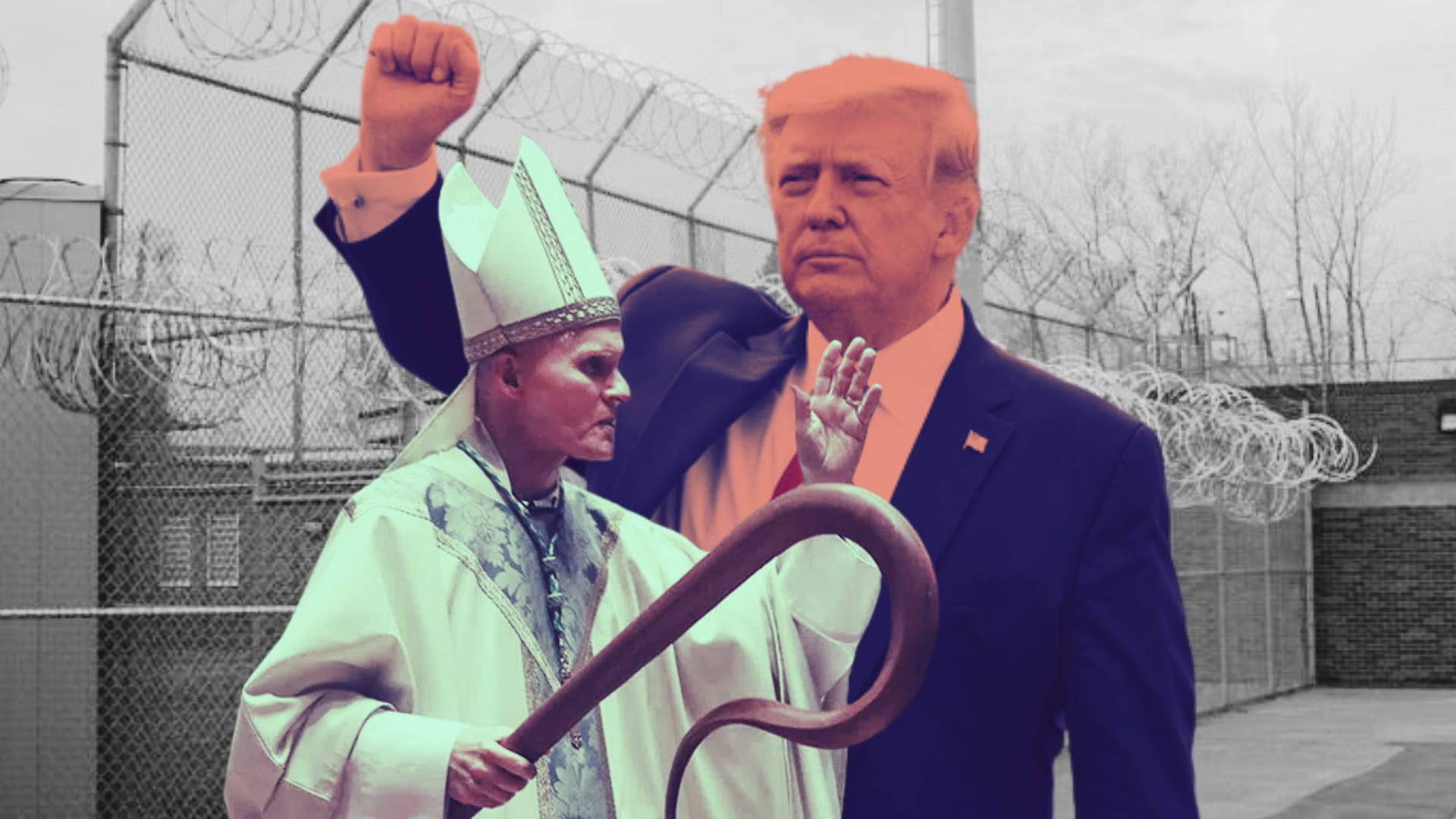
The bishops predictably condemned it, releasing a statement condemning dehumanizing language and insisting that national security and human dignity are not in conflict.
That’s all fine and true. But it’s also another example of the Bishop’s strategy for dealing with the Trump administration, which hurts their cause more than it helps.
How a father corrects a son
The US bishops seem to be speaking out of both sides of their mouth.
They say national security matters, but then it seems like Trump can never do anything right when it comes to actually securing the border. The bishops oppose more detention centers and higher rates of arrest. They’ve condemned “mass deportation” as a matter of course.
But if the deportation of a dangerous criminal is a good thing, what exactly is wrong with doing it en masse? If there’s been a mass importation—which there has been—the only remedy would be a mass deportation.
A Bishop, like a good father, cannot only give negative condemnation. He must also give positive direction. If I tell my son, “don’t go this way, son’t go don’t go that way,” eventually he gets frustrated and asks which way he’s supposed to go. If I never answer, he will go his own way and stop listening to me.
The same is true of the state under the care of the Church. When the bishops give nothing but condemnation, people—including faithful Catholics—tune them out. It becomes white noise.
Offer a positive vision
So let me offer what positive direction might actually sound like.
The bishops could acknowledge the legitimate good of deporting people who are clearly violating our laws—the traffickers, the fraudsters, the violent. They could insist that detention facilities provide access to the sacraments and decent conditions. They could critique the messaging: this is a serious issue, so treat it seriously and stop wasting time making memes about it.
Then they could deal honestly with Catholic Charities, which receives a sizable share of its funding from the federal government. When you have a twenty-million-dollar payroll and twenty million dollars in government money, losing that money hurts—it hurts your ability to keep the doors open and keep your employees’ mortgages paid. That is a massive vulnerability that has given one political party an outsized influence over the Church. Mixing government money into the Church is a red flag and an open door for partisanship.
The bishops should want to be independent enough to give aid prudently, beholden to neither party.
But their relationship with federal grants seems to cloud their judgment when choosing how to interact with the US government.
The perceived double standard
I’m writing all of this in charity. I know any criticism of the hierarchy gets read as disobedience. I don’t intend it that way.
But notice the double standard.
The bishops were hesitant to criticize Joe Biden directly and to deny him communion because they wanted to maintain a relationship—and they did. But they won’t extend that same grace to Catholic Republicans.
I think the bishops are afraid to work with Republicans out of a fear of being seen as partisan, like what has happened to Bishop Barron. I’m afraid that ship has sailed.
The public perception is that the bishops are willing to work with politicians who champion intrinsic evils like abortion with leniency, but not those who differ with them on prudential matters like immigration.
The bishops are seen as partisan to the left, and they must work to change that.
Synodality, walking together, dialogue, etc., are the bishops’ own stated goals, and you cannot dialogue with half the country from behind a press release. Think of what would happen if a bishop met with the vice president somewhere neutral, or in his own home, talking immigration off the record and as friends.
Politics is a network of friends making decisions together. Public condemnation via press releases serves only to alienate.
How to win back the people
Trump won the popular vote running on deportation.
There are members of their flock, even a majority, who have seen mass immigration policy harm their communities. When the bishops condemn what these people voted for, without ever talking to them, they don’t change their minds. They just see the bishops as out of touch and stop listening.
If the bishops are right that Trump’s policies are immoral—and for this article, I’ll assume they are—then it is more important, not less, to build the relationships with Republicans and be heard. Of the two parties, the Republicans are the ones more willing to listen to orthodox Catholics. Every frontrunner for the Republican primary in 2028 is a Catholic.
They’re not perfect, no Catholic statesman ever is, but the bishops are gambling a decade of the Church’s influence over public life on the assumption that condemnation works. It doesn’t.
So which is it? Do we want to win over the corporate press that hates us already or win over the people who have the potential to move public policy in a Catholic direction?
Because we cannot have both, and time is running out.
This, exactly, right here. I see you’re already getting pushback in the comments, which is insane, because you are clearly correct
And the criticism Bishop Barron has gotten for maintaining communication WHILE still joining his voice along with the rest of the bishops in condemnation of some of Trump’s actions has been borderline deranged online
A fantastic write. It’s sad, but we have almost wholly disregarded a lot of what the USCCB thinks. We simply can’t trust them because they are so partisan. They’re like a figurehead at this point.
The current USCCB would put Margaret Sanger in their ranks if they could.