


Catholics love to talk about why young people are leaving the Church.
Their theory is usually flavored by their own experience. Whatever got them to take their faith seriously, they assume that’s the main issue for everyone else.
It’s because priests are (or aren’t) talking about political issues from the pulpit. It’s because we have terrible schools or CCD. It’s because of liturgy or sex or whatever.
All of those may be reasons.
But they aren’t the most common reason.
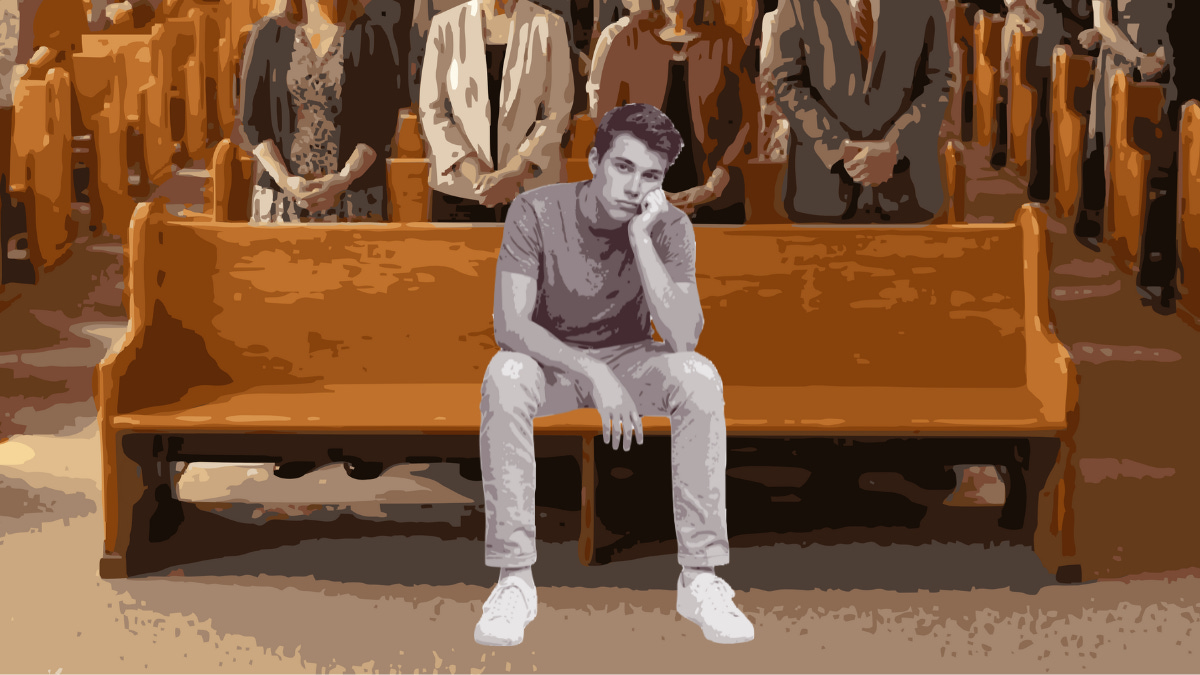
According to Pew Research, the number one reason young people leave the Church is they “gradually drifted away.” Another survey of young people asked what they’re looking for in a church, and the number one answer was “a good community.”
Young adults leave because they gradually drifted away.
They come back because of community.
Both of these are fixed if we build better communities.
These statistics hold true with my own experience.
Many of my friends from youth ministry in high school were on fire for Christ. Their community was regularly inviting them to pray, talking about the faith, and challenging them to go deeper.
But once they went away to college and lost that community, they got busy, they stopped going to Mass. If they had a community holding them accountable, they likely never would have left.
These young adults never had a specific doctrinal gripe with Catholicism, they just drifted.
Thanks be to God, many of those same friends eventually came back after they found community at a church. They had a family, needed to find friends, they went back to a church, and met other people.
If we want our churches to be more attractive to young people, we need to strengthen our communities.
Typically, the first reaction to this is defensive.
“Community is not the most important thing.”
And that’s true, community is not the most important thing. Encountering Christ through the sacraments is the most important thing in the Christian life.
But look at Christ’s own actions in His life.
Yes, He gave us the Eucharist as the ultimate thing. It’s the last thing he did with his disciples. But first He spent three years with them. And before that, He spent thirty years with His family in His hometown. Jesus focused on community before liturgy, even though liturgy is why He came to Earth.
Community is not first in priority but it is first chronologically. A full church requires good community. You can’t skip it.
I see the parish like a building. The ground floor, the place where people enter is community. But the first floor, the priority, is initiating people into the liturgical life of the Church.
So if you’re someone dedicated to growing your parish, I highly recommend you focus on building relationships at the parish. Find the people that are lonely or are about to drift away. Make sure they know someone at the parish is waiting for them on Sunday.
This will do more to keep people Catholic than you think.
In my book, Save Your Parish, I talk about how to build a community at your parish even if you’re a busy mom with a bunch of young kids and no time.
Save Your Parish is available February 2.
Good insight. I think this thought is definitely worth delving into more deeply. I share the frustration that people (myself included) are often looking for someone/thing to pin all the blame on (the clergy, the liturgy, the Diocese, the Boomers, etc.) and rarely do we collectively take responsibility for our evangelical mission.
This one was excellent. I would only make the minor point that unfortunately we have all been psychologically programed by the modern culture into the Enlightenment Philosophical error of "rugged individualism" and also been made into seeing the Sacraments as separate from the community aspect of the Church which is another error. The Eucharist is "the source and summit of our Faith" and there is a "universal call to Holiness" as Vatican II beautifully said. But, both of those things always occur within the context of Community. Even if a hermit priest in the desert consecrates and consumes the Eucharist alone, he is not really alone because he is receiving Holy *Communion*. He is communing together with all Saints, Purgatory Souls, and everyond who receives worthily or without mortal culpability at every mass. And the job of hermits is not to be seen as pure isolation. Their job is to pray for all of our needs, it is to keep themselves as clean and virtuous as possible for the purpose of more powerful prayer for us all. And this is only for those legitimately uniquely called. It would be sinful for them to view themselves as purely isolated from us or rejecting fellowship with us.