


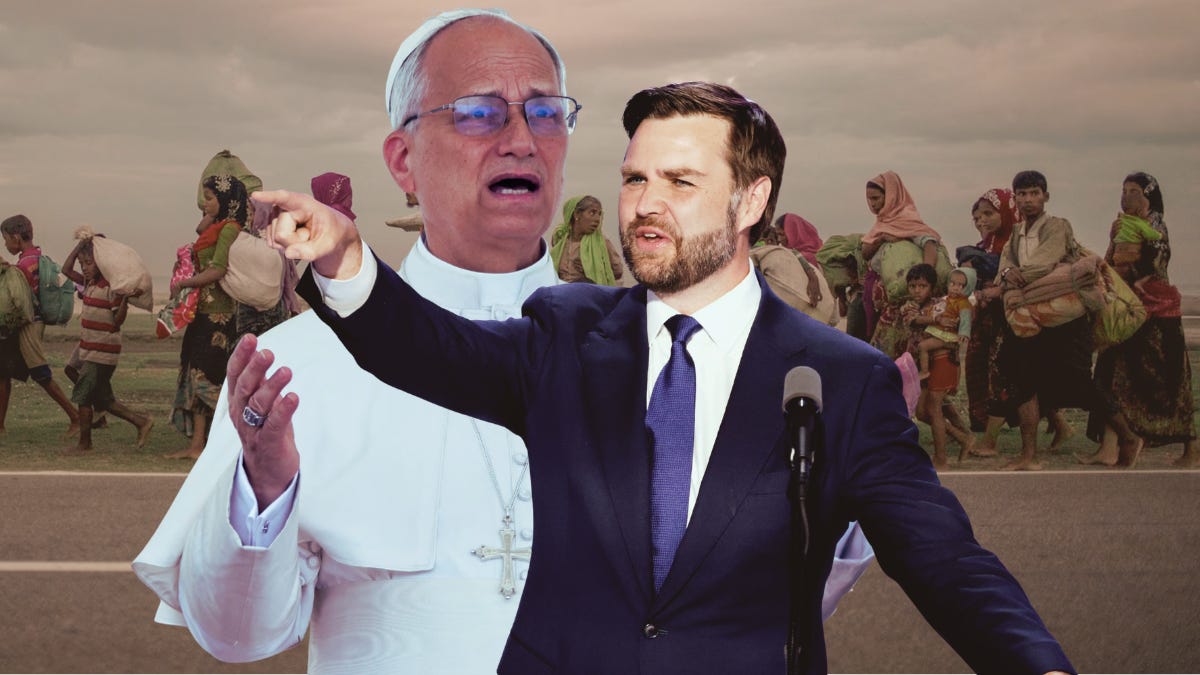
Yesterday, Pope Leo posted on X about immigration.
Since the sentiment was relatively pro-migrant, the right freaked out, continuing the trend of shooting themselves in the foot when engaging the Church.
But Pope Leo’s statement could be entirely consistent with the conservative position on immigration in America right now.
The right must work to understand the Church’s position on immigration, and stop acting like the Church is against them.
The Church has a preferential option for the poor
The Church’s position on immigration can be summed up in the social doctrine of the preferential option for the poor. This is the principle that the Church focuses on the interests of the poor and speaks out on their behalf. Often, the poor are shoved to the margins of society and have few advocates.
The preferential option for the poor is a logical conclusion of the principle of the common good.
“Common” means both “shared” and “ordinary.” We cannot have a “common good” unless the “commoner” is included. People often overlook the commoner in politics, so the Church takes on a responsibility to rectify that.
That said, the Church’s preferential option for the poor is not an exclusive option.
She does not support the poor at the expense of the wealthy, the elite, or wealthier nations. But she recognizes that the powerful, the wealthy, and the developed nations often have enough resources to fight for themselves.
They don’t need the Church fighting on their behalf.
Pope Leo’s position is conservative
Pope Leo said the migrant crisis should prick at the consciences of nations, both origin nations and what he called transit nations.
We can glean two things from his phrasing.
First, he recognizes that the current scale of mass immigration is a crisis, i.e., not a good thing. He rightly points out that people are willing to risk their lives on little boats crossing the Mediterranean rather than stay in their places of origin. This should be a sign to those home countries that something has gone terribly wrong; he is basically admonishing origin countries for being corrupt and treating their citizens poorly.
Second, by talking about “transit nations,” he recognizes that refugee status is supposed to be temporary. An issue we face in America is that many seek asylum as a path to become permanent residents, but Pope Leo refers to Western nations as transit countries, saying this should be a temporary measure, and eventually, people return.
The funny thing is, he is talking about everybody except the right. The global left does not see itself as transit countries; they are purposefully importing migrants to increase the labor pool and expand their election base.
You can hold a completely closed-border, mass-deportation position and still say exactly what Pope Leo is saying.
But whenever he talks like this, conservatives immediately assume he’s admonishing them, which makes them look guilty. Instead, they could respond by saying, “Yes, origin nations should get better, and we should act as transit nations with a plan to return people to their home countries as soon as possible.”
Conservatives should argue from compassion
American conservatives need to reframe their argument against mass migration.
Third-world migration is indeed harming wealthy, first-world nations. However, when you put it like that, it sounds like the rich are being inconvenienced for the sake of the poor. That is not a sympathetic position, and it doesn’t sound like the preferential option for the poor.
The right needs to loudly proclaim that it is on the side of the poor American who bears the brunt of illegal immigration.
These are people tied to their hometowns who can’t leave when refugees arrive en masse to take up jobs and houses. They are the ones dealing with driven-down wages, forced to compete with migrants willing to take less. This shows a preferential option for the poor. The right needs to lean into this if it wants to be taken seriously by the Vatican as a faithful Christian movement, rather than just a nationalist populist movement.
The right is in a populist moment, and the preferential option for the poor is ripe for the picking. Right-wing media pundits refuse to see it, stuck in a 2013 reactionary, persecuted mindset. If you want to argue for closing the border and deporting dangerous migrants, you should do it with the Church, not against it. There is nothing inherently immoral about deportation; it’s often a just act.
The right needs to stop antagonizing the Pope, or we will have another situation where the Pope only hears from conservatives when they criticize him.
That won’t win over the hearts and minds of the Church.
Why people don’t listen to the bishops’ criticisms of Trump

Last week, the Trump administration released aliens.gov, a website built around a 1950s sci-fi theme that compares illegal immigrants to alien invaders from outer space.
Very well-written. We need more of this. This is what I would consider the to be in line with the true dual-purpose of Journalism:
- Holding the authorities accountable, on every side and at all times.
- Informing the general public
In ordinary speech, transit countries are simply the non-destination countries through which migrants pass to their destination, e.g., Honduras → Mexico → the United States; Senegal → Morocco → Spain. Pope Leo's language follows this: countries of origin, transit countries, Europe, and finally the international community. To read "transit nations" as referring to Western destination countries themselves requires importing a meaning that the text does not bear. If that had been his intention, one would expect him to explicitly say that Europe should function as a temporary refuge and to explicitly describe Western nations as 'transit nations'. Instead, Europe is singled out as a distinct category with its own moral responsibilities apart from these 'transit nations'. (i.e., to receive anyone who enters their territorial waters for the sake of human dignity, etc.)
This form of coping makes the Pope into a kind of crypto-populist, supposedly signaling agreement with the nationalist right while lacking the courage to say so openly. The far simpler explanation is that he means exactly what he says: origin countries have obligations, transit countries have obligations, and Europe has obligations (supposedly to receive whosoever shows up). I do not know whether you wish to say the Pope is a coward or malicious; the choice is yours, the meaning is apparent to those with eyes and ears.
I do not know how one could say that a "closed-border, mass-deportation position" is consistent with "serious processes of reception and integration", but I would enjoy seeing you distinguish and twist yourself into a pretzel to explain.