


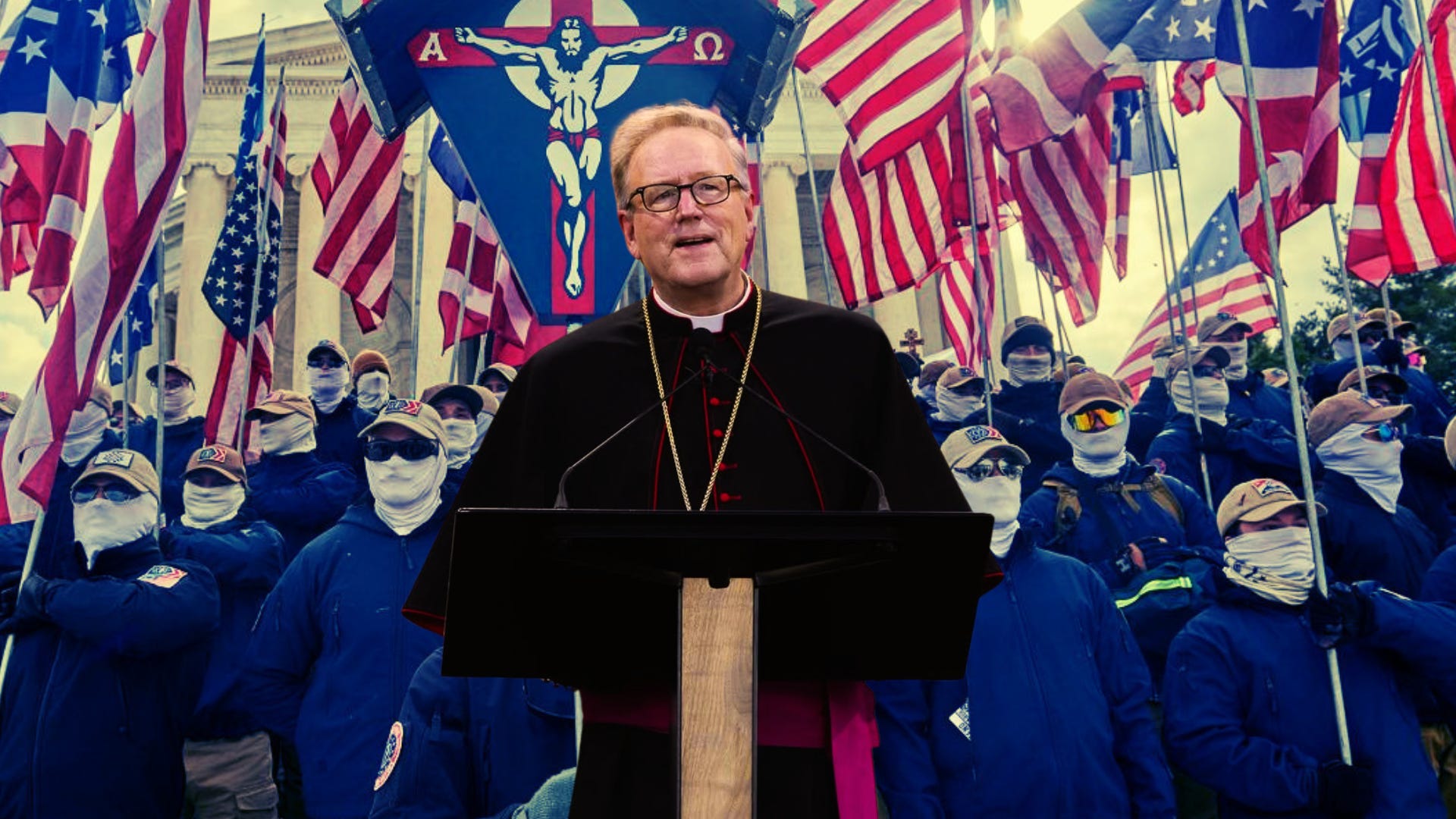
This week, a Christian rally was held in Washington, DC, hoping to “rededicate” America as a Christian nation. The first instinct of many in the Catholic world is to turn our nose up at it. It smacks too much of “political Christianity” or worse, “Christian nationalism.”
But the rally was an unequivocal good.
Men like Bishop Barron and Cardinal Dolan need to stand alongside Vance, Rubio, and Hegseth. Whatever brand of “Christian nationalism” these three hold, the Church needs to engage it.
Catholics have historically recognized the grievances and virtues of other modern ideologies like liberalism and socialism.
It’s time we extend the same grace to the nationalists.
One Nation Under God
The first instinct of a lot of Catholics, particularly online, is to turn our noses up at events like this. They assume the politicians are acting in bad faith and Catholic leaders are wrong for engaging. I’m not denying there is a political motive to this rally—these politicians want to win votes—but we should look at the base they are trying to rally.
There is now a populist movement of American Christians, socially conservative and economically left-wing, who feel disaffected by the absence of Christ in public life. This movement is called, both as a term of derision and a term of pride, Christian nationalism.
Like all buzzwords, “Christian nationalism” means what you want it to mean, but at its core, it is the belief that the nation has its own integrity and identity, and a belief that the good of the nation is achieved primarily through being a majority Christian nation.
And Catholics—particularly the apolitical, college-educated, suburban kind—recoil from Christian Nationalism.
Christian Nationalism is poor-coded
The main reason why we recoil is that the Christian Nationalist movement is heavily coded as poor. The political cartoon Christian Nationalist is overweight, wearing a wife-beater and a MAGA hat, and lives in a trailer park.
This characterization of the movement should be the signal to Catholics that we are required to listen. The Church’s preferential option for the poor requires we engage the poor as our equals in society and in our political conversation, even if we find them brash and uncouth.
The poor have real grievances and are seeking genuine goods. The Church ought to listen to them and do what it does best when engaging with modernist ideologies.
All modern ideologies are a reaction to legitimate grievances and are pursuing a genuine good. When dealing with these ideologies, the Church has historically acknowledged both the grievance and the good, but corrected its errors and brought in line with reality.
The Church ought to do the same thing with nationalism.
The Catholic response to modern ideology
There are three dominant ideologies. They stem from the three stated values of the French Revolution: Liberty, Equality, and Fraternity.
The dominant modern ideologies emphasize one of these values at the expense of the others:
Liberty became liberalism; the highest good is individual autonomy.
Equality became socialism; the highest good is economic/social equality.
Fraternity became fascism; the highest good is the integrity of the nation.
There are legitimate evils perpetrated in the name of liberalism (abortion) and socialism (Holodomor). Yet, the Church was able to recognize the good sought and the grievances aired.
Fascism and its little brother, nationalism, also have legitimate evils perpetrated in the quest for the integrity of the nation. The Church has no problem denouncing these evils. But we seem to have a hard time recognizing the good being sought by nationalists and, yes, even fascists.
The Catholic Church needs to do three things
Acknowledge the legitimate grievances of nationalists
Acknowledge the genuine good they are seeking
Critique their ideology in good faith
The grievance and the good of nationalism
The grievance of the Christian nationalist is that our country’s identity, once majority Christian, is being eroded, especially through artificial means like the mass importation of foreigners by the government.
The immigration numbers are not organic. Federal immigration programs have changed the cultural makeup of small towns across the country, often through duplicitous and careless means. That is a legitimate grievance.
That town’s identity is changing because integration and assimilation do not happen at that large a scale, especially if those immigrants are not Christian, since Christ is the ultimate point of unity among people of different nations.
In response to this grievance, the nationalist is reaching for a genuine good: national integrity. Their growing nationalism is a desire for their neighborhood, town, parish, and nation to have some sort of continuity that can be passed on to their children and grandchildren.
How to correct nationalism
The correction we owe nationalism is in its friend-enemy distinction. The fascist philosopher Carl Schmitt argued in The Concept of the Political that political power is the ability to determine who is an enemy.
However, Christians do not unite around a common enemy, but a common friendship. Friendship is forged in pursuit of a common good, and greater friendship is found by pursuing more of the same goods together.
Mass immigration makes it difficult, if not impossible, for the immigrants to be brought into the circle of friendship into which they immigrate. If the community is 50% Somali Muslim and 50% American Protestant, the two groups have almost nothing in common and will create two parallel communities with competing interests.
On the other hand, when immigration happens slowly, a point of friendship can be found with the existing community, and assimilation can happen. The more points of similarity—the more common goods sought—the quicker it can happen without violating the integrity of the community
The Catholic correction is that immigration will and should happen, but not at such a scale that it violates the integrity of the local communities they enter.
Christ is the point of unity
At Pentecost, the Spirit descended, and the Apostles preached the Gospel to all nations. They were able to speak so each person heard the Gospel in his own native tongue. For the first time since the scattering of the nations at Babel, the people were united under Christ.
That project of uniting the nations continues today through the Catholic Church.
The global liberal regime we find ourselves under is seeking to be that point of unity—uniting all people as atomized individual citizens of the world. But they will fail. Our humanity is not enough to unite us. Only Christ can.
Only Christ’s Church is capable of uniting the nations, and Pentecost shows that He unites the nations as nations, each with their own identity and integrity.
As our nation seeks to reclaim its national integrity, it is paramount that the Church engage with this project, lest we find ourselves with some other principle of unity—an enemy—that will serve only to fracture us. Christ must stand as the point of unity for our nation, and the Catholic Church must be there to preach Him.

The fact that it’s poor-coded is underdiscussed.
The proles that are looked down upon for being "nationalist" are also the ones who suffer the most from underclass immigration. Wealthy people interact with immigrants by using them to drive down servile labor costs, and their kids go to school with the immigrant software engineer's kids. Where I grew up, immigrants move in and play loud Reggaeton constantly, drive down my peer's wages through competition, form gangs, and weaponize their race to get opportunities at Heritage American's expense.
I appreciate you posting this because it opposes the Replacement agenda, and I know that's an unpopular opinion among the powerful. Thank you.