


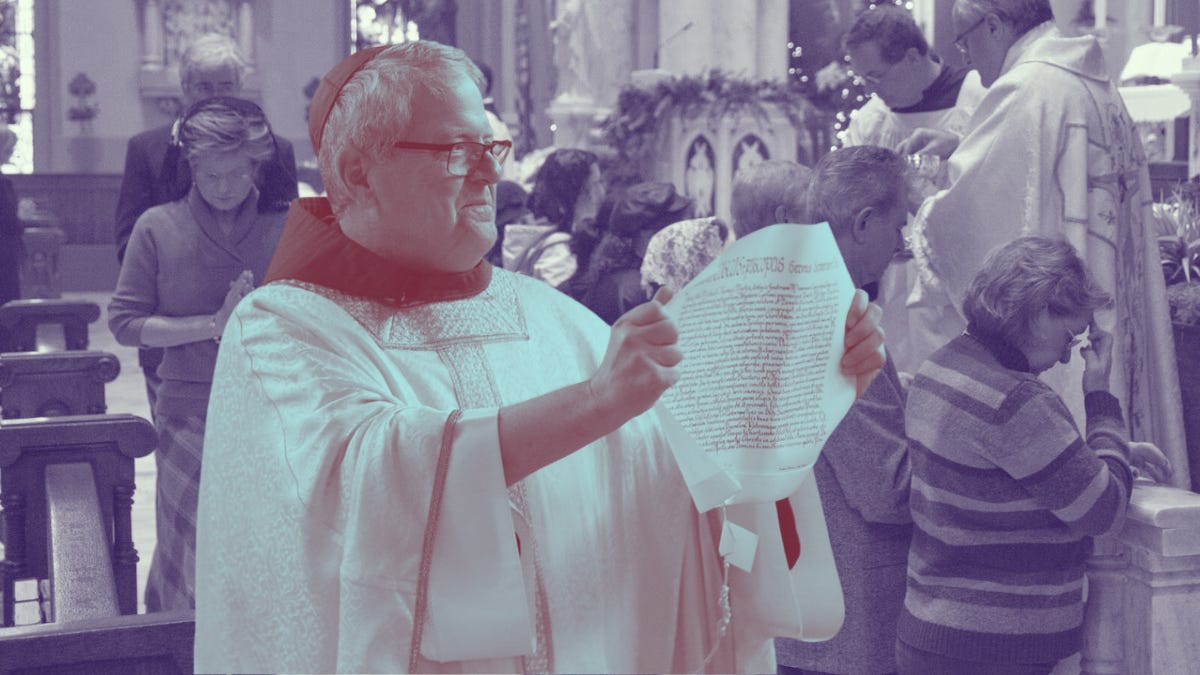
Bishop Martin of Charlotte just banned communion kneelers from all churches in the diocese.
His reasoning was threefold.
Standing during Communion is the norm in the United States.
Receiving in the same posture promotes unity.
Everyone walking up to Communion together symbolizes our “pilgrim journey.”
This isn’t new.
Back in May, a draft document leaked showing the bishop’s broader plan—a systematic crackdown on traditional Catholics throughout the diocese. Not just Latin Mass attendees. Even Novus Ordo Catholics who lean traditional. The reaction was so unpopular the document was never officially released.
This is a bad move by Bishop Martins, and it fails for three reasons.
The “appeal to norms” is tone deaf
It’s hard for lay Catholics to hear a bishop demand they follow the norms of the Mass after decades of watching so many priests deviate from those norms.
Many Catholics want to receive Communion the way Catholics have for centuries. Even if that isn’t the “norm” there is room for that desire to be accommodated.
What there is NOT room for in the GIRM are the countless deviations from clergy that lay Catholics have to suffer through regularly: The ad-libbed prayers, the stand-up routine homily, the skits during Mass, etc.
A priest friend put it perfectly:
No one has ever thought “everyone received communion the same way, that was such a great sign of unity”
What they do think is, “how come Father Bill uses different words than Father Duplenticy during Mass?”
The damage to unity is not when people receive kneeling. The damage is done when one church in the diocese does Mass by the book and the other parish down the road is the Father So-and-So Show.
That’s what causes confusion in a diocese. Not people kneeling.
If the bishop wants to appeal to the norms, fine. But make sure priests are following them first. Out of goodwill, bishops and priests need to adhere to the book before they expect the faithful to do it.
The principle is applied inconsistently
If the Bishop Martin were cracking down on a liturgical abuse on the part of the laity, that would be one thing. But he’s cracking down on a practice that is allowed during the Mass.
The General Instruction of the Roman Missal (GIRM) does say standing to receive communion is the norm in US dioceses. But it also allows the faithful to kneel if they want. There’s room for personal piety.
One could argue he is trying to prevent an out-of-the-ordinary practice from becoming ordinary. The problem is that the principle is being applied inconsistently.
If it were consistent, he would also ban extraordinary ministers of Holy Communion. That practice is by definition not normative, but the practice has become normative in most parishes in America.
Is the bishop cracking down on those, too?
Nope. In fact, he encourages an increase in the use of extraordinary ministers to a ratio of 1 EM for every 75 parishioners “To facilitate the timely distribution of Holy Communion.”
That’s what’s frustrating. Traditional Catholics get punished for deviating from norms in a way that’s more reverent while other more progressive deviations are accepted.
The principle of “adherence to norms” only seems to go in one direction.
He creates the division he seeks to avoid
The bishop thinks banning kneelers will create unity.
It won’t.
Unity doesn’t mean uniformity. We’re all receiving the same Lord, oriented toward the same eternal life with Him in heaven. That is the unity we have in Christ.
By banning a pious practice, especially one that was the norm in the Church for centuries like kneeling at communion, you won’t bring people together. You will signal to them that they are not welcome here. That your preferred expression of piety is superior to theirs.
Many Catholics feel more connected to God through traditional practices, naturally. We should be okay with that. We should embrace the tradition of our ancestors and accommodate people who want to engage with it—while respecting the liturgical norms of Vatican II.
Both can coexist.
Banning kneelers creates resentment and makes certain pious practices difficult for many Catholics.
For example, kneelers help people who have a hard time getting up and down. I can kneel on the floor if I want. Not everybody can. If an older person wants to kneel, the priest should be able to let them.
A Warning to Bishops
This story is just another installment in a saga that has gone on for decades. If we don’t stop it soon, we will do irreparable damage to the unity of our Church.
The story goes like this: A traditional priest makes a traditional change, there’s an uproar from more progressive parishioners, and he’s forced to back down. On the other hand, when a progressive change happens and the traditionalists get upset, the progressive rarely backs down.
The institutional Church, with its commitment to “listening,” has selective hearing. It appears it only listens to the outrage of the older progressive and ignores the younger traditionalist.
I say “appears” because I earnestly believe the majority of bishops and priests do not want to create this dichotomy. Most bishops I have spoken to are aware of how many Catholics love traditional liturgy and are seeking to accommodate that desire.
I also know many clerics are afraid to accommodate traditional liturgy.
They are afraid of the angry emails and difficult conversations with people who are worried we are going back to “before Vatican II.” (The horror!)
I hope our leaders choose to take on these difficult conversations. I hope they do not choose comfort over shepherding their people.
We need to end the crackdown on traditional Catholics. It’s not helping. Traditional Catholics are faithful. They love the Church. They love Christ. So why punish them?
That should be our posture toward traditional Catholics. And we should adopt that posture quickly, lest we make enemies out of friends.
"Everyone walking up to Communion together symbolizes our 'pilgrim journey.'" As if we don't all walk up the same aisle when going to an altar rail lol
I truly don't want to be uncharitable but this feels like doubling down on something just for the sake of it because he'd rather do that than admit he was wrong